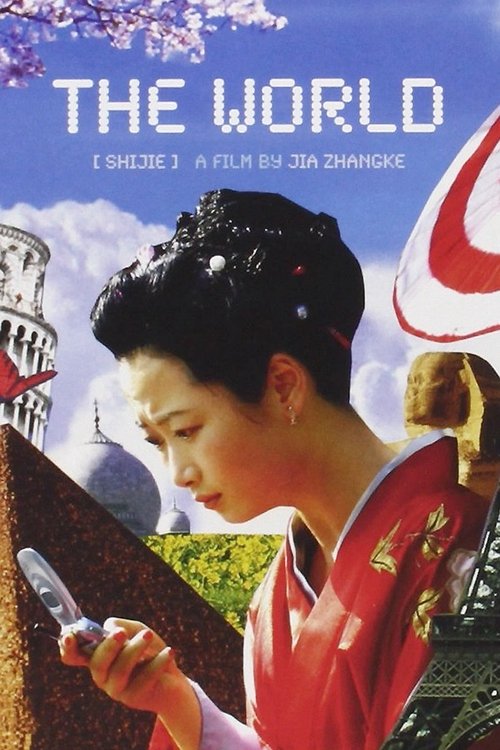
The World (2004)
- Original title
- 世界
- Directed by
- Jia Zhangke
- Genre
- drama film
- Country
- People's Republic of China, France
- Runtime
- 2h 20m
- Rated
- TP
- Rating
- 7.0 of 10 from 76 voters
- Elsewhere
- IMDb
The catalogue in 3D
The film shelves have a room of their own that you can walk around in. The cat behind the counter is the AI Catbot, and they pick real films from the same catalogue when you tell them what you feel like watching. Nothing is for sale, here or in there. Go in from here and this film is already out on the counter, with more like it waiting on the shelf next to it.
How it feels
Young rural migrants work as performers and laborers at a Beijing theme park filled with miniature world landmarks. The film shows their everyday struggles and relationships, revealing the gap between the park’s fantasy and their real lives.
melancholicslow-burngroundedobservationalsomberunderstatedbittersweetwistful
What happens
The World (Chinese: 世界; pinyin: Shìjiè) is a 2004 Chinese film written and directed by Jia Zhangke, starring Zhao Tao and Cheng Taishen. It was his first film shot outside his hometown of Shanxi Province, and also the first of his works to be granted official production approval by the Chinese government. The inspiration for The World came from a 2003 conversation between Jia and Zhao Tao, in which she recounted her experience working as a dancer at Shenzhen’s “Window of The World,” a theme park filled with miniature versions of international landmarks. This inspired Jia to explore the gap between fantasy and survival for China’s urban underclass and the symbolic role of such theme parks in shaping the spectacle of globalization. However, the film was ultimately set in Beijing World Park, a similar attraction on the outskirts of the capital. The film is set in early 21st-century China, during a time of accelerated integration into the social transformation of globalization. It follows a group of young rural migrants, including performers and security guards working at World Park, and some construction workers employed elsewhere in the city. The migrant’s lives were swept up in the spectacle of modernization and global consumer culture, where personal dreams frequently clashed with structural realities. Although they appeared to be at the center of a stage representing The World, this “world” is merely a glamorous surface built for tourist consumption. Their jobs still remained low-paid, repetitive, and precarious. The migrants are still trapped in cycles of emotional isolation, unstable employment, and social marginalization. Stylistically, scholar David Richler notes that Jia Zhangke departs from his usual observational realism in The World, incorporating computer animation and digital effects to express emotional dislocation and imagined mobility (Richler 7). The film blends documentary-style cinematography with animation and electronic music, blurring the boundaries between reality and fantasy, local and global. Through the spatial logic and symbolic function of the theme park, Jia Zhangke presents a lived condition in which the promise of “freely traversing The World" masks a reality of constrained mobility. The film highlights the structural limitations and class immobility faced by marginalized individuals in post-socialist urban China. The World premiered in competition at the 61st Venice International Film Festival on September 4, 2004, and received critical acclaim for its subtle yet powerful portrayal of contemporary Chinese urban life and its complex entanglement with global spectacle. (from Wikipedia, CC BY-SA)
More like this
 Soap Opera (2004)
 Day and Night (2004)
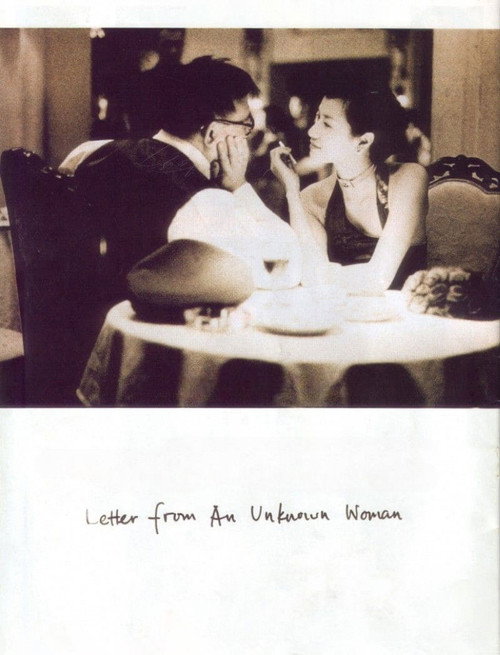 Letter from an Unknown Woman (2004)
 Jasmine Women (2004)
 2046 (2004)
 Passages (2004)
 My Bittersweet Taiwan (2004)
 Ash Is Purest White (2018)
- More like this film, on a shelf you can walk up to.It's the lit case on the top shelf.