Thought Moments (2004)
- Directed by
- Michael Simon Toon
The catalogue in 3D
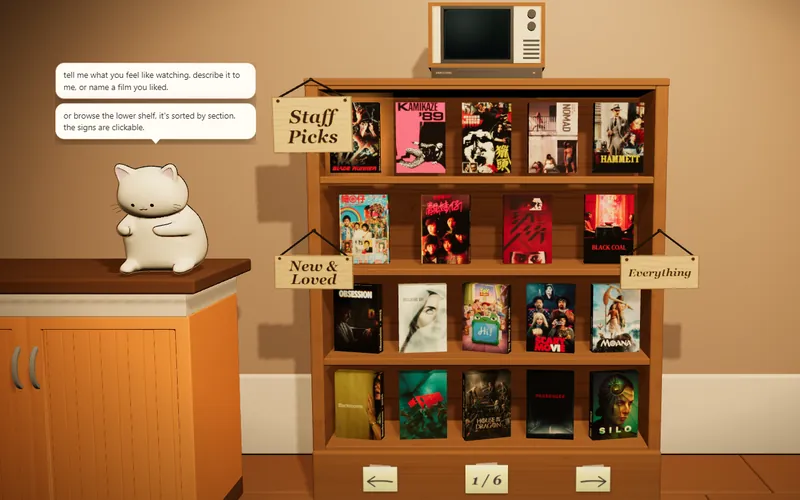
The film shelves have a room of their own that you can walk around in. The cat behind the counter is the AI Catbot, and they pick real films from the same catalogue when you tell them what you feel like watching. Nothing is for sale, here or in there. Go in from here and this film is already out on the counter, with more like it waiting on the shelf next to it.
How it feels
This short film interviews strangers in public places across the United Kingdom asking emotionally charged questions. It captures their split second facial reactions using variable frame rates to highlight microexpressions. The director applies a consistent visual style to compare how different people express similar feelings.
observationalintimatefocusedanalyticalneutralcarefulrestrainedclinical
What happens
Thought Moments (2004) is an anthropological short film in the style of cinéma vérité by Michael Simon Toon. Toon, a former Buddhist monk, titled Thought Moments after the Buddhist term for the mental states we experience when a physical or mental object enters the mind. The film is used in the study of microexpressions, eye accessing cues, and the universality of facial expressions. Toon (off camera) interviews a diverse sample of individuals in public places across the United Kingdom asking a set of ten simple but emotionally evocative questions. The film uses variable frame rates to highlight distinct emotions, as well as their sequence and timing, that each individual expresses within seconds or fractions of a second after being asked questions, such as "What do you love most?" "Are you happy or sad?" and "What are you afraid of?" Consistency of composition, lighting, and contrast facilitates the analysis of both the differences and similarities of the interviewees' facial expressions. Toon also released a version of the film with superimposed theoretical eye accessing cue chart. Both versions are studied and reproduced by students of psychology in several languages. (from Wikipedia, CC BY-SA)
More like this
 Winner Takes All (2004)
 A Kiss on the Nose (2004)
 The Miserables (2010)
 Words in Progress (2004)
 Private Talks (2004)
 What Are You Having? (2003)
 Lucian Freud: Portraits (2004)
 Pozdrav video kasetama! (2010)
- More like this film, on a shelf you can walk up to.It's the lit case on the top shelf.