Arrivée d'un train gare de Vincennes (1896)

- Original title
- Arrivée d'un train (gare de Vincennes)
- Directed by
- Georges Méliès
- Genre
- documentary film, silent film
- Country
- France
- Runtime
- 1 min
- Rated
- U
- Rating
- 4.2 of 10 from 16 voters
- Elsewhere
- IMDb
The catalogue in 3D
The film shelves have a room of their own that you can walk around in. The cat behind the counter is the AI Catbot, and they pick real films from the same catalogue when you tell them what you feel like watching. Nothing is for sale, here or in there. Go in from here and this film is already out on the counter, with more like it waiting on the shelf next to it.
How it feels
A silent actuality film showing a train arriving at the Vincennes station near Paris. It captures a brief everyday scene from the late 19th century in a single unedited shot.
observationalshortstatichistoricaleverydaystraightforwardmatter-of-fact
What happens
Georges Méliès (1861–1938), a French filmmaker and magician, made a variety of short actuality films between 1896 and 1900. Méliès was established as a magician with his own theater-of-illusions, the Théâtre Robert-Houdin in Paris, when he attended the celebrated first public demonstration of the Lumière Brothers' Kinetoscope in December 1895. Unable to purchase a camera from the Lumières, who insisted that the venture had no future, he bought a film projector and some films from the British film experimenter Robert W. Paul and began projecting them at the Théâtre Robert-Houdin. Meanwhile, Méliès studied the principles on which Paul's projector ran, and in 1896 was able to modify the machine so that it could be used as a makeshift camera. At first, Méliès followed the custom of the time, and the example memorably set by the pioneering Lumières, by producing actuality films—brief "slice of life" incidents made by preparing naturalistic scenes for the camera or by filming events of the day. These "cityscapes, scenic views, and domestic vignettes" closely followed the model already set by the Lumières and their salaried operators, who had already been sent to various points abroad to publicize the Lumière camera and bring home actualities filmed in foreign climes. All told, Méliès filmed 93 films, or 18% of his entire output, outdoors as actuality footage. However, Méliès was also interested in expanding his line of films to include less common genres. His second film, Conjuring, captured a theatrical magic act on film; his sixth, Watering the Flowers, moved into comedy, remaking the Lumière's influential L'Arroseur Arrosé. Following his discovery of the substitution splice in 1896, Méliès moved further into fiction and trick films, building his own studio on his property in Montreuil, Seine-Saint-Denis to allow for the filming of his theatrically inspired, storytelling-based scènes composées—"artificially arranged scenes." His last nonfiction work was the seventeen-part Paris Exposition, 1900 film series. Because of his move away from actualities into fiction, he is generally regarded as the first person to recognize the potential of narrative film. In an advertisement, Méliès proudly described the difference between his innovative theatrical films and the actualities still being made by his contemporaries: "these fantastic and artistic films reproduce stage scenes and create a new genre entirely different from the ordinary cinematographic views of real people and real streets." (from Wikipedia, CC BY-SA)
More like this
 L'Arrivée d'un train en gare de La Ciotat (1896)
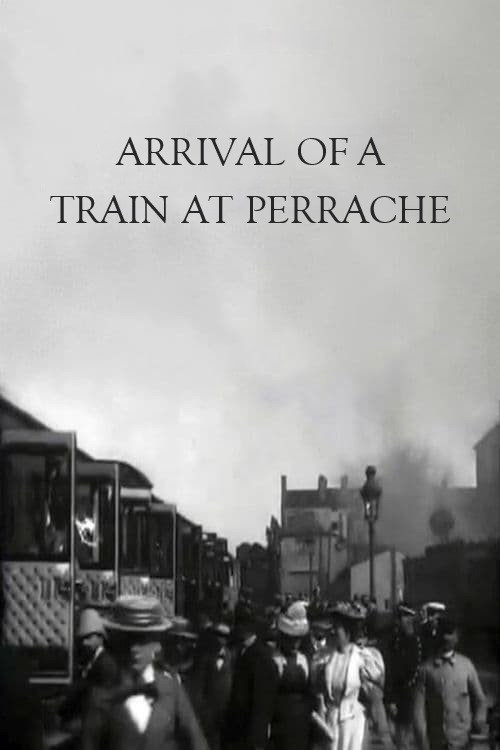 Arrival of a Train at Perrache (1896)
 Arrival of a Train (Joinville Station) (1896)
 Arrivée d’un train à Battery Place (1896)
 Départ des automobiles (1896)
 Panorama de l'arrivée en gare de Perrache pris du train (1896)
 Déchargement d'un navire (1896)
 The Return to the Stable (1896)
- More like this film, on a shelf you can walk up to.It's the lit case on the top shelf.