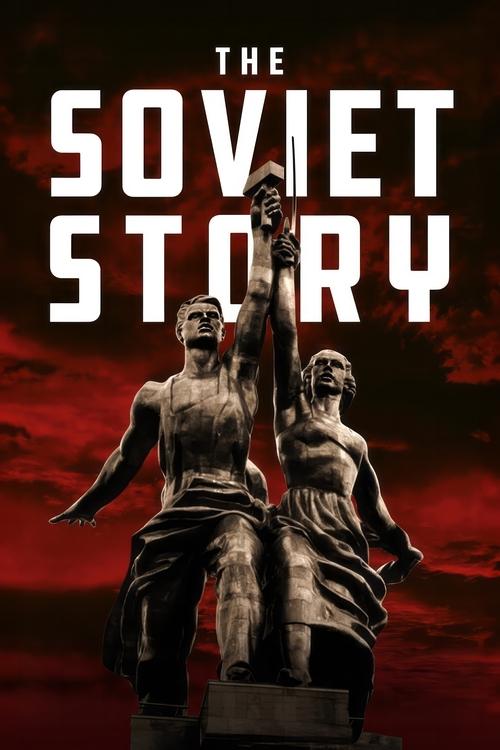
The Soviet Story (2008)
- Original title
- Padomju stāsts
- Directed by
- Edvīns Šnore
- Genre
- documentary film, propaganda film
- Country
- Latvia
- Runtime
- 2h 05m
- Rating
- 7.4 of 10 from 40 voters
- Elsewhere
- IMDb

The catalogue in 3D
The film shelves have a room of their own that you can walk around in. The cat behind the counter is the AI Catbot, and they pick real films from the same catalogue when you tell them what you feel like watching. Nothing is for sale, here or in there. Go in from here and this film is already out on the counter, with more like it waiting on the shelf next to it.
How it feels
This documentary argues for close ideological and practical links between Nazi Germany and the Soviet Union. It uses interviews and archival footage to examine atrocities like the Holodomor, the Great Purge, and the Katyn massacre.
disturbingbleaksoberinginformativeharrowingaccusatorygrimfactual
What happens
The Soviet Story is a 2008 documentary film about the Soviet Union and Soviet–German relations before 1941 and after, written and directed by Edvīns Šnore, and sponsored by the Union for Europe of the Nations group in the European Parliament. The film features interviews with Western and Russian historians such as Norman Davies and Boris Vadimovich Sokolov, the Russian writer Viktor Suvorov, the Soviet dissident Vladimir Bukovsky, members of the European Parliament, and participants and survivors of the Soviet terror. Using those interviews, together with historical footage and documents, the film documentary argues that there were close philosophical, political and organisational connections between the Nazi and the Soviet systems. It highlights the Lenin's hanging order, the Great Purge, the Holodomor, the mass graves in the Soviet Union, the Molotov–Ribbentrop Pact, the Katyn massacre, the Gestapo–NKVD collaboration, the German-Soviet military parade, the German–Soviet Axis talks, the NKVD prisoner massacres, forced population transfer in the Soviet Union, and the medical experiments in the gulags. The documentary goes on to argue that the successor states to Nazi Germany and the Soviet Union differ in the sense that postwar Germany condemns the actions of Nazi Germany, but the opinion in contemporary Russia is summarised by a quote from Vladimir Putin: "One needs to acknowledge that the collapse of the Soviet Union was the greatest geopolitical catastrophe of the century." In the closing credits of the film, it is stated: "The Soviet Union killed more than 20,000,000 men, women and children. This film is dedicated to them." (from Wikipedia, CC BY-SA)
More like this
 Debt To Afganistan (2008)
 ...Igarka, Cerība un Taurenis (2008)
 The Jewish Street (1992)
 My Mother's Farm (2008)
 Red Terror on the Amber Coast (2008)
 Forgotten Transports to Belarus (2008)
 Our land and Liberty. Bermontiade (2009)
 Kokaru dziesmusvētki (2008)
- More like this film, on a shelf you can walk up to.It's the lit case on the top shelf.