Speaking in Tongues (2009)

- Genre
- documentary film

The catalogue in 3D
The film shelves have a room of their own that you can walk around in. The cat behind the counter is the AI Catbot, and they pick real films from the same catalogue when you tell them what you feel like watching. Nothing is for sale, here or in there. Go in from here and this film is already out on the counter, with more like it waiting on the shelf next to it.
How it feels
This documentary follows children in American public school classrooms where teachers speak only Mandarin, Cantonese, or Spanish. It shows how young students learn to understand these languages through signals and repetition. The film looks at the growth of bilingualism in the 21st century.
informativeobservationalneutralthoughtfulhopefulstraightforwardeducationalcalm
What happens
Speaking in Tongues is a 2009 documentary film that focuses on the language barrier within society. Spanning 60 minutes this documentary is programmed by California Visions. It included languages of English, Mandarin, Cantonese and Spanish. Directed by Marcia Jarmel and Ken Schneider it was released April 2009 in the United States but has languages such as English, Mandarin, Cantonese, and Spanish. The documentary spans inside American Immersion school systems. This film illustrates Americans in the 21st Century and the growth of bilingualism. Speaking in Tongues begins in a public kindergarten classroom made up of white students and Asian American students. What is different about this traditional American classroom is the teacher only speaks Mandarin, Cantonese, or Spanish to her students. Because these children are so young they are not becoming frustrated by the language barrier instead they are interested and fascinated by something they are not used to. This process takes time but teaches the children to remember and focus on signals and speech repetition to eventually comprehend what language is being taught to them. By only hearing a language they are not accustomed to, they have no opportunity to confide in English, their first language. The ideal time to become bilingual is before the age of 13. Within the film, every student was immersed before this age. Learning more than one language benefits the brain by increasing the flexibility of one's brain. Immersion, which also called Language immersion is known as teaching a new language to a group of students solely through that language. Language Immersion is currently being used across the United States but has yet been shown on films other than "Speaking in Tongues". (from Wikipedia, CC BY-SA)
More like this
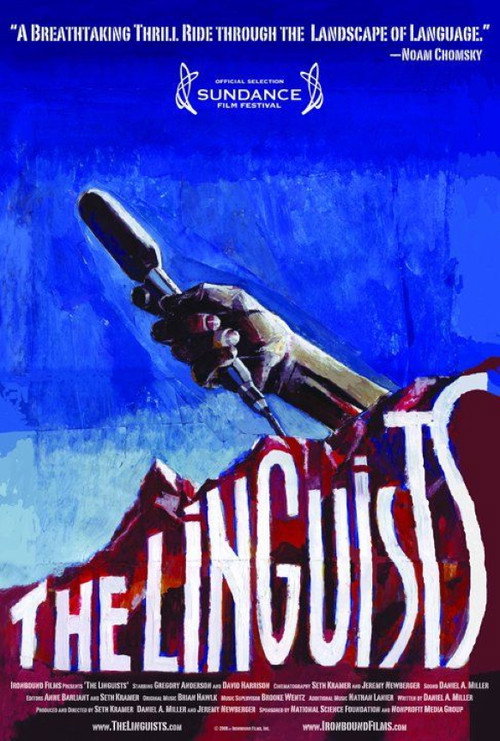 The Linguists (2008)
 Flunked (2008)
 Hollywood Chinese (2007)
 A Foreign Language (1958)
 Ciudadanos de segunda (2007)
 Conlanging - The Art of Crafting Tongues (2017)
 We Are the People We’ve Been Waiting For (2009)
 Why Do These Kids Love School? (1999)
- More like this film, on a shelf you can walk up to.It's the lit case on the top shelf.