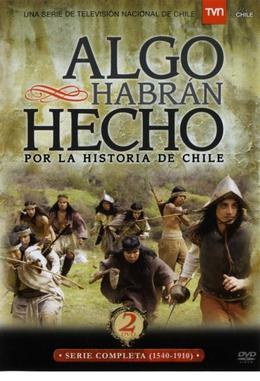
Algo habrán hecho por la historia de Chile (2011)
- Genre
- documentary film
- Country
- Chile
- Elsewhere
- IMDb
The catalogue in 3D
The film shelves have a room of their own that you can walk around in. The cat behind the counter is the AI Catbot, and they pick real films from the same catalogue when you tell them what you feel like watching. Nothing is for sale, here or in there. Go in from here and this film is already out on the counter, with more like it waiting on the shelf next to it.
How it feels
This documentary series presents the history of Chile from Spanish colonization to its centennial in 1910. A historian and an actor host the show, which uses both actors recreating events and other visual styles to tell the story.
educationalhistoricalnarrative-driveninformativepacedseriousstructuredfactual
What happens
Algo habrán hecho por la historia de Chile (Spanish: They sure did something for the history of Chile) is a documentary television miniseries that narrates the history of Chile. It has the format of the Argentine documentary film Algo habrán hecho por la historia argentina, and it was aired by Televisión Nacional de Chile as part of the Bicentennial of Chile celebrations. The documentary is hosted by historian Manuel Vicuña and the actor Francisco Melo, reprising the roles of Felipe Pigna and Mario Pergolini in the Argentine documentary. The documentary was based on investigations by Andrea Larroucau, Juan Carlos Arellano, Jorge Martin, Carolina Odone and María José Schneuer, and the support of Hernán Rodríguez, Alejandra Araya and Fernando Purcell. The documentary narrates the history of Chile, from the Spanish colonization by Pedro de Valdivia and the begin of the Arauco War, to the Centennial of Chile in 1910. In the interim, the documentary deals with the Chilean War of Independence, the Chilean civil wars, the War of the Confederation, the War of the Pacific, among others. The documentary uses two main styles, jumping from one to the other. One style is the use of actors to represent certain key events. The second style is the plain explanation of the things taking place, which could be done with visual gags, with the hosts in some modern day location, or at a representation of an event. The use of jokes or visual gags, however, is very limited, and the documentary does not have the humoristic tone of the Argentine one; and the acted passages are longer and more detailed. (from Wikipedia, CC BY-SA)
More like this
 Un país serio (2010)
 Al final de la escapada (2011)
 Ojos rojos (2010)
 The Death of Pinochet (2011)
 The Eternal Memory (2023)
 12 días que estremecieron Chile (2011)
 Sembrando Libertad
 En la cuerda floja (2001)
- More like this film, on a shelf you can walk up to.It's the lit case on the top shelf.