Final Straw: Food, Earth, Happiness (2015)
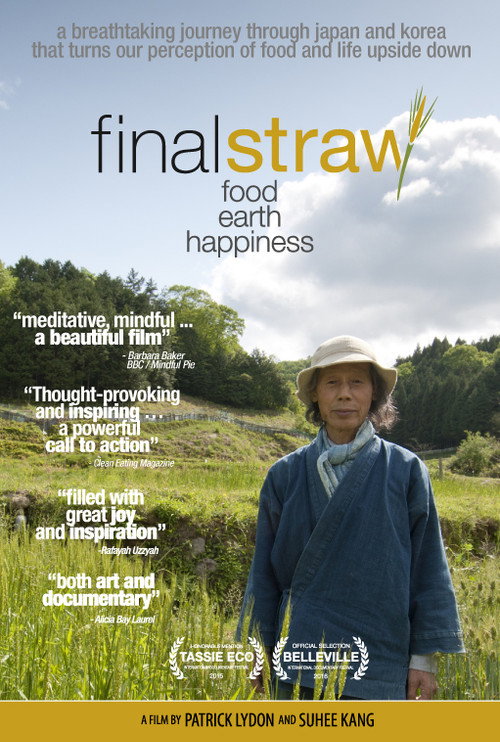
- Directed by
- Patrick M. Lydon, Suhee Kang
- Genre
- documentary film
- Country
- United States
- Runtime
- 1h 15m
- Rated
- NR
- Elsewhere
- IMDb

The catalogue in 3D
The film shelves have a room of their own that you can walk around in. The cat behind the counter is the AI Catbot, and they pick real films from the same catalogue when you tell them what you feel like watching. Nothing is for sale, here or in there. Go in from here and this film is already out on the counter, with more like it waiting on the shelf next to it.
How it feels
A documentary following filmmakers as they travel to farms and cities in Japan, South Korea, and the United States. They interview people who practice natural farming, a method inspired by Masanobu Fukuoka's ideas.
contemplativehopefuleducationalcalmearthlyreflectiveobservationalorganic
What happens
Final Straw: Food, Earth, Happiness is a documentary/art film released in June 2015 that takes audiences through farms and urban landscapes in Japan, South Korea, and the United States, interviewing leading practitioners in the natural farming movement. The film—inspired by the work of Masanobu Fukuoka, and his book The One Straw Revolution—came about when an environmental artist (Patrick M. Lydon) and an environmental book editor (Suhee Kang) had a chance meeting in Seoul, South Korea, and began conducting short interviews together with leaders in the ecology and social justice movements. During an interview with Korean farmer Seong Hyun Choi, the two were so impressed by his ecological mindset and way of working that they set out to produce a feature film about the wider natural farming movement in Japan and Korea. Lydon and Kang ended up quitting their jobs, giving away most of their possessions, and becoming voluntarily homeless for four years in order to afford producing the film. The film is split into three sections 1) Modern Life, 2) Foundations and Mindset of Natural Farming, and 3) Natural Farming in Practice and Life. According to the filmmakers, as they began to understand more about how natural farming itself was not rooted in methods, but in a way of thinking, they chose to explore the life philosophies and ways of thinking of natural farming practitioners in a more free-flowing and artistic way, rather than an instructive one; the result is an unconventional documentary that features slow paced musical interludes alongside interviews. (from Wikipedia, CC BY-SA)
More like this
 Off the Menu: Asian America (2015)
 A Sower of Seeds 2 (2015)
 I Want to Stay an Ant (2015)
 Can You Dig This (2015)
 蘇生 (2015)
 Unity (2015)
 どこかに美しい村はないか (2020)
 武蔵野 (2018)
- More like this film, on a shelf you can walk up to.It's the lit case on the top shelf.