Your Hit Parade (1950)

- Directed by
- Norman Jewison
- Genre
- reality
- Country
- United States
- Length
- 1 season, 3 episodes
- Rating
- 7.0 of 10 from 2 voters
- Elsewhere
- IMDb
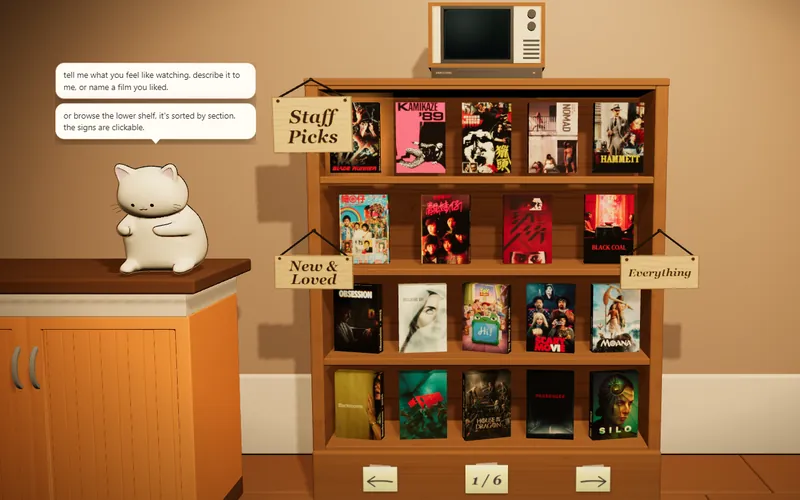
The catalogue in 3D
The film shelves have a room of their own that you can walk around in. The cat behind the counter is the AI Catbot, and they pick real films from the same catalogue when you tell them what you feel like watching. Nothing is for sale, here or in there. Go in from here and this series is already out on the counter, with more like it waiting on the shelf next to it.
How it feels
This is a TV music show that counted down the most popular songs each week. Orchestra leaders and singers performed the top hits for a television audience.
nostalgicupbeatbriskretrocheerfullightheartedpredictablewholesome
What happens
Your Hit Parade is an American radio and television music program that was broadcast from 1935 to 1953 on radio, and seen from 1950 to 1959 on television. It was sponsored by American Tobacco's Lucky Strike cigarettes. During its 24-year run, the show had 19 orchestra leaders and 52 singers or groups. When the show debuted, there was no agreement on its title. The press referred to it by several names, with the most common being "Hit Parade", "The Hit Parade", "The Lucky Strike Hit Parade", and "The Lucky Strike Parade". The program title officially became "Your Hit Parade" on November 9, 1935. Every Saturday evening, the program offered the most popular and bestselling songs of the week. The earliest format involved a presentation of the top 15 songs. Later, a countdown with fanfares led to the top three finalists, with the number one song for the finale. Occasional performances of standards and other favorite songs from the past were known as "Lucky Strike Extras". Listeners were informed that the "Your Hit Parade survey checks the best sellers on sheet music and phonograph records, the songs most heard on the air and most played on jukeboxes, an accurate, authentic tabulation of America's taste in popular music." However, the exact procedure of this "authentic tabulation" remained a secret. Some believe song choices were often arbitrary due to various performance and production factors. The show's ad agencies—initially Lord and Thomas and later Batten, Barton, Durstine & Osborne—never revealed the specific sources or the methods that were used to determine top hits. They made a general statement that it was based mainly on "readings of radio requests, sheet music sales, dance-hall favorites and jukebox tabulations"; Radio Guide claimed "an endless popularity poll on a nationwide scale." (from Wikipedia, CC BY-SA)
More like this
 Cavalcade of Bands (1950)
 The Chesterfield Supper Club (1956)
 Once Upon a Tune (1951)
 Penthouse Party (1950)
 The Colgate Comedy Hour (1950)
 Holiday Hotel
 Hullabaloo (1965)
 Star of the Family (1950)
- More like this series, on a shelf you can walk up to.It's the lit case on the top shelf.