M*A*S*H (1972)

- Genre
- black comedy, comedy drama, war film, medical drama, comedy television program
- Country
- United States
- Length
- 11 seasons, 256 episodes
- Rated
- TV-PG
- Rating
- 7.9 of 10 from 750 voters
- Elsewhere
- IMDb

The catalogue in 3D
The film shelves have a room of their own that you can walk around in. The cat behind the counter is the AI Catbot, and they pick real films from the same catalogue when you tell them what you feel like watching. Nothing is for sale, here or in there. Go in from here and this series is already out on the counter, with more like it waiting on the shelf next to it.
How it feels
A team of doctors and support staff work at a mobile army hospital during the Korean War. They cope with the horrors of war through irreverent humor, pranks, and a constant battle against military bureaucracy.
wrysardoniclightheartedbleakfast-pacedbittersweetensemble-drivenseriocomic
What happens
M*A*S*H is an American war comedy drama television series that aired on CBS from September 17, 1972, to February 28, 1983. It was developed by Larry Gelbart as the first original spin-off series adapted from the 1970 film of the same name, which, in turn, was based on Richard Hooker's 1968 novel MASH: A Novel About Three Army Doctors. The series, produced by 20th Century-Fox Television, follows a team of doctors and support staff stationed at the "4077th Mobile Army Surgical Hospital" in Uijeongbu, South Korea, during the Korean War (1950–1953). The ensemble cast originally featured Alan Alda and Wayne Rogers as surgeons Benjamin "Hawkeye" Pierce and "Trapper" John McIntyre, respectively, as the protagonists of the show. They were joined by Larry Linville as surgeon Frank Burns, Loretta Swit as head nurse Margaret "Hot Lips" Houlihan, McLean Stevenson as company commander Henry Blake, Gary Burghoff as company clerk Walter "Radar" O'Reilly, Jamie Farr as orderly Maxwell Klinger, and William Christopher as the chaplain, Father John Mulcahy. Over the run of the show, several members of the main cast were replaced: Wayne Rogers was replaced by Mike Farrell as B. J. Hunnicutt, McLean Stevenson was replaced by Harry Morgan as Sherman Potter, Larry Linville was replaced by David Ogden Stiers as Charles Emerson Winchester III, and, when Gary Burghoff left the show, the Maxwell Klinger character moved into the company clerk role. Longtime supporting cast members included Kellye Nakahara, Jeff Maxwell, Johnny Haymer, Allan Arbus, Edward Winter and G. W. Bailey. The series varied in style and tone—including broad comedy and tragedy—which can be attributed to fluctuating writing staff over the life of the show and the variety of sources contributing to the stories, such as actor Alan Alda and surgeons who served in the Korean War. The show's title sequence features an instrumental version of "Suicide Is Painless", the original film's theme song. The show was created after an attempt to film the original book's sequel, M*A*S*H Goes to Maine, failed. The television series is the best known of the M*A*S*H works and one of the highest-rated shows in U.S. television history and is regarded by many as one of the greatest television shows of all time. Its final episode, "Goodbye, Farewell and Amen", was the most-watched television broadcast in the United States from 1983 to 2010, and it remains both the most-watched finale of any television series and the most-watched episode of a scripted series. (from Wikipedia, CC BY-SA)
More like this
 MASH (1970)
 House M.D. (2004)
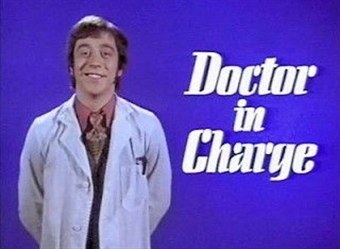 Doctor in Charge (1972)
 Scrubs (2001)
 Band of Brothers (2001)
 Emergency! (1972)
 Descendants of the Sun (2016)
 68 Whiskey (2020)
- More like this series, on a shelf you can walk up to.It's the lit case on the top shelf.