Old Friends... New Friends (1978)

- Genre
- documentary, talk
- Country
- United States
- Length
- 2 seasons, 20 episodes
- Elsewhere
- IMDb
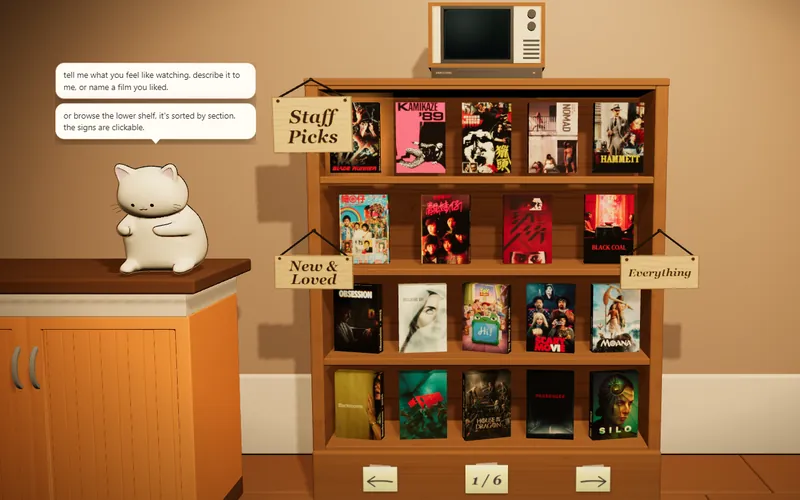
The catalogue in 3D
The film shelves have a room of their own that you can walk around in. The cat behind the counter is the AI Catbot, and they pick real films from the same catalogue when you tell them what you feel like watching. Nothing is for sale, here or in there. Go in from here and this series is already out on the counter, with more like it waiting on the shelf next to it.
How it feels
Fred Rogers hosts a documentary series where he interviews guests in their own homes or hometowns. The show focuses on the lives and stories of older adults, with episodes sometimes including items sent in by viewers.
gentlereflectiveintimatecalmconversationalwarmslow-pacednostalgic
What happens
Old Friends ... New Friends is an American television documentary series created and hosted by Fred Rogers during his hiatus from producing Mister Rogers' Neighborhood. Produced by Family Communications, Inc., it originally aired on PBS from April 15, 1978, to September 25, 1980. An episode begins with Rogers walking into the WQED-TV production studio, greeting staff members, and then walking onto a living room set, where the main content of the episode begins. He would give introductory remarks, then the episode would segue to on-location interviews with the episode's guests conducted by Rogers. The interviews often take place at the guests' home or hometown. The episode would end with a transition to Rogers giving concluding remarks. This format varies in some episodes. Some feature Rogers giving a monologue about his own life. Some episodes focuses on subject matters and guests suggested by Rogers' viewers. The series also features items sent by Rogers' viewers, which include letters, family photos, and patches of fabric from their favorite old clothing. Rogers said he created the series to address his observation that older generations were becoming increasingly isolated from younger generations. He said the series addresses the problem by having "each episode [being] based on the central philosophical assumption that older people are an integral and formative part of all our lives, an essential part of the human family." He said the series emphasizes the fact that "each one of us makes a difference in this world.", which he said was also emphasized in Mister Rogers' Neighborhood. He said the series addresses the problem by also focusing on a variety of guests: those who are young, old, unknown, or famous, and making viewers "understand enduring relationships and interactions between people of all generations." Reception of the series was largely negative. Critics identified many problems, which includes Rogers' inability to let go of his childlike persona from Mister Rogers' Neighborhood, the series' failing to give viewers a comprehensive understanding of complex relationships between its guests, the series' lack of focus on dramatic moments, and Rogers' inability to coax his guests into revealing their feelings. A former colleague of Rogers said that Rogers was not as intimately connected with the series and experienced with running it as he was with Mister Rogers' Neighborhood. Some critics said the series has some exceptionally compelling episodes, which includes Rogers' ability to make one of his guests, Lee Strasberg, reveal his personal feelings, and the series' dramatic portrayal of William Wasson and two of his adopted orphans, which was described as having "an incredible sensitivity for the feelings of others." (from Wikipedia, CC BY-SA)
More like this
 Won't You Be My Neighbor? (2018)
 Mister Rogers' Neighborhood (1968)
 A Beautiful Day in the Neighborhood (2019)
 The Real West (1992)
 Bold Journey (1956)
 Flick Flack (1974)
 The Oldtimers (1974)
 The Story of Us with Morgan Freeman (2017)
- More like this series, on a shelf you can walk up to.It's the lit case on the top shelf.