La Madrastra (1981)

- Original title
- La madrastra
- Genre
- telenovela
- Country
- Chile
- Length
- 1 season, 107 episodes
- Rating
- 5.7 of 10 from 3 voters
- Elsewhere
- IMDb

The catalogue in 3D
The film shelves have a room of their own that you can walk around in. The cat behind the counter is the AI Catbot, and they pick real films from the same catalogue when you tell them what you feel like watching. Nothing is for sale, here or in there. Go in from here and this series is already out on the counter, with more like it waiting on the shelf next to it.
How it feels
A woman is wrongly convicted of murder in the United States. After twenty years in prison she returns to Chile seeking revenge and to reconnect with her children by posing as their stepmother.
emotionalmelodramatictenseslow-burnmelancholicgrippingrevenge-drivennostalgic
What happens
La Madrastra (lit: The Stepmother) is a Chilean television soap opera created by Arturo Moya Grau, that aired on Canal 13 from April 21 to September 18, 1981, starring Jael Unger and Walter Kliche. The series, set in Los Angeles and Santiago between 1961 and 1981, depicts the memoirs of Marcia Espínola, a woman wrongfully accused of murder in America. Twenty years later, she is freed from prison, returning to Chile for revenge, and to see her children as their stepmother. La Madrastra having achieved both wide acclaim and commercial success with 80% television ratings, became a significant part of the 1980s Chilean popular culture. Directed by Óscar Rodríguez and comprising a total of 75 episodes, the series has been consistently ranked by Latin American media as one of the greatest television screenplay in Spanish language of all time, and has been remade several times by other television networks. La Madrastra has been cited as a key influence on Chilean television productions inspiring screenwriters until now. International versions has been adapted and rebranded as Vivir un poco (1985), Para toda la vida (1996), Forever (1996), La Madrastra (2005), ¿Quién mató a Patricia Soler? (2014) and the most recent La madrastra (2022). (from Wikipedia, CC BY-SA)
More like this
 Casagrande (1981)
 Las herederas (1983)
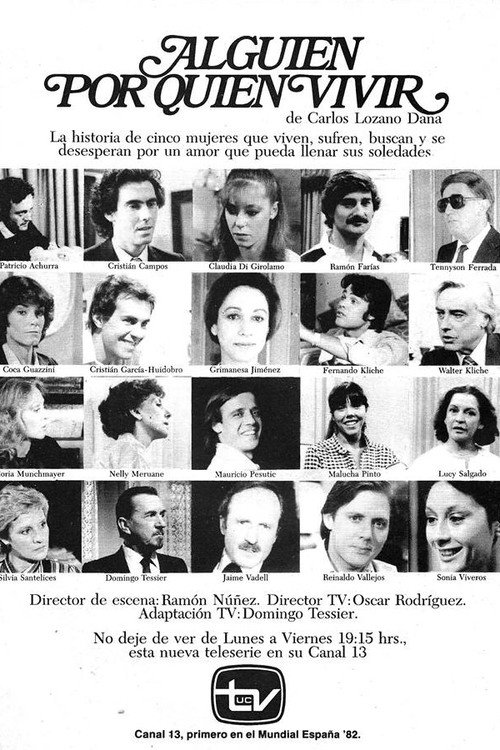 Alguien por quien vivir (1982)
 Villa Los Aromos (1981)
 Celos (1982)
 La amortajada (1971)
 Alguien Te Mira (2007)
 El juego de la vida (1983)
- More like this series, on a shelf you can walk up to.It's the lit case on the top shelf.