Ich heirate eine Familie (1983)

- Directed by
- Peter Weck
- Genre
- family television series
- Country
- Germany, Austria
- Length
- 4 seasons, 14 episodes
- Rated
- 6
- Rating
- 7.1 of 10 from 10 voters
- Elsewhere
- IMDb
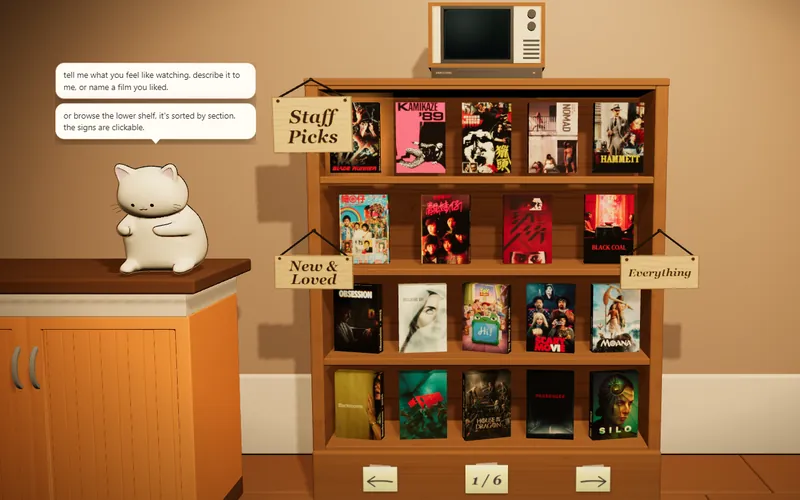
The catalogue in 3D
The film shelves have a room of their own that you can walk around in. The cat behind the counter is the AI Catbot, and they pick real films from the same catalogue when you tell them what you feel like watching. Nothing is for sale, here or in there. Go in from here and this series is already out on the counter, with more like it waiting on the shelf next to it.
How it feels
A divorced mother of three runs a small boutique in Berlin while her friends try to set her up with a commercial artist. They meet and start secretly dating, but he does not yet know she has children.
lightheartedwarmgentleplayfulromanticdomesticheartfeltbittersweet
What happens
Ich heirate eine Familie (I am marrying a family) is a television series that aired from 1983 to 1986 on German television network ZDF. 14 episodes were produced. Curth Flatow wrote the screenplays, while all episodes were directed by Peter Weck. The show's music is composed by Alain Goraguer. The divorced Angelika "Angie" Graf (Thekla Carola Wied) lives with her three children, teenage daughter Tanja (Julia Biedermann) and younger sons Markus and Tom, in West Berlin, where she runs a small children's boutique. Her friends Sybille "Bille" (Maria Sebaldt) and Alfons Vonhoff (Herbert Bötticher) are convinced that Angie needs a new man in her life. Thus, they try to pair her off with Vienna-born commercial artist Werner Schumann (Peter Weck), a divorcee himself, who is watched over by his curious and jealous housekeeper Mrs. Raabe (Bruni Löbel). Bille and Alfons' idea first does not work out when Werner unexpectedly shows up with his current girlfriend at the party they organize to bring Angie and Werner together. However, Angie and Werner get to know each other and end up secretly dating, but Werner does not know about Angie's children at first. The screenplay includes strong, ironic dialogues and ensures some slapstick, above all the character of Werner with his Viennesse charm is a pillar of the story. In contrast to Schumanns' happy relationship is the dysfunctional marriage of Bille and Alfons. Flatow processed autobiographical experiences in his script after himself marrying a woman with several children. The role of Werner was originally given to Harald Juhnke with Peter Weck only directing, but Juhnke's alcoholism caused the producers to cast Weck as leading character. (from Wikipedia, CC BY-SA)
More like this
 Der Trotzkopf (1983)
 Gestern bei Müllers (1983)
 Die Schöngrubers (1972)
 Christian und Christiane (1982)
 Wenn der Vater mit dem Sohne (1971)
 Goldene Zeiten – Bittere Zeiten (1981)
 Auf immer und ewig (1995)
 Unternehmen Rentnerkommune (1978)
- More like this series, on a shelf you can walk up to.It's the lit case on the top shelf.