Matchless Raijin-Oh (1991)
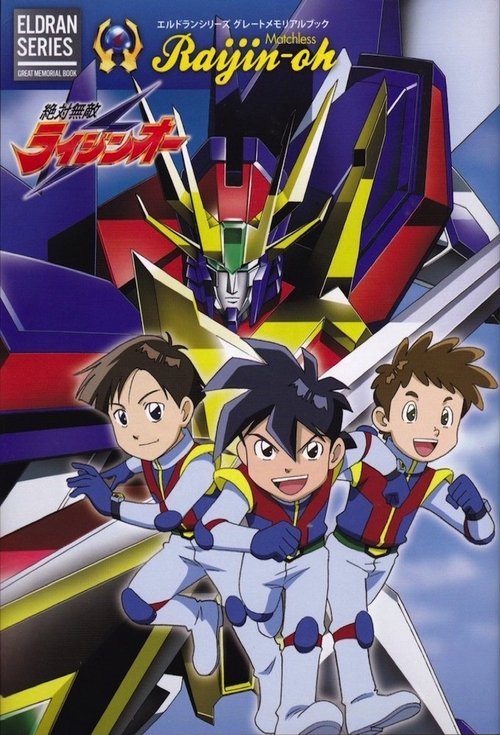
- Original title
- 絶対無敵ライジンオー
- Genre
- school anime and manga, mecha, Adventure, Mecha, Sci-Fi, Action
- Country
- Japan
- Length
- 1 season, 51 episodes
- Rating
- 6.3 of 10 from 3 voters
- Elsewhere
- IMDb
The catalogue in 3D
The film shelves have a room of their own that you can walk around in. The cat behind the counter is the AI Catbot, and they pick real films from the same catalogue when you tell them what you feel like watching. Nothing is for sale, here or in there. Go in from here and this series is already out on the counter, with more like it waiting on the shelf next to it.
How it feels
Elementary school kids get to pilot a giant robot to protect Earth from an evil empire. The series follows their adventures as they balance school life with fighting villains.
lightheartedenergeticplayfulteam-orientedhopefulwhimsicalbrisk-paced
What happens
Matchless Raijin-Oh (絶対無敵ライジンオー, Zettai Muteki Raijin-Oh; lit. Absolutely Invincible Raijin-Oh) is a 51 episode Japanese anime television series, and the first generation Eldran franchise funded by Tomy and produced by Sunrise. It aired in Japan from April 3, 1991 to March 25, 1992 and later be succeeded by the second generation of the Eldran series Genki Bakuhatsu Ganbaruger. The story revolves around a group of elementary school children who are given command of a mecha named Raijin-Oh and their efforts to defend the Earth from the evil Jaaku (evil) Empire. There is also a four-episode OVA sequel. Anime Midstream, Inc. announced in December, 2008, that it acquired the license for and planned to release the anime series Matchless Raijin-Oh in the U.S. sometime in 2009 as their first anime release. The company began selling the first volume of the series direct from their website, as well as several other online retailers as of late December 2009. The first volume contained episodes 1–5. The second volume, containing episodes 6–10, was released in September 2010, and translated the title beginning with this volume (and current printings of the first volume are now also marketed under that title). The third volume was released on July 12, 2011, containing episodes 11–15. Each volume contains English and Japanese audio, as well as special features such as music videos, clean openings/closings, voice bloopers, and the third volume contains an audio commentary with several of the English voice actors. Two more volumes were released on June 30, 2012 for volume four and July 1, 2013 for volume five. The rest of the series was released as a five-disc boxset; the Season 2 Collection, released on September 30, 2014. However, this set is in Japanese with English subtitles only. (from Wikipedia, CC BY-SA)
More like this
 Nekketsu Saikyō Go-Saurer (1993)
 Genki Bakuhatsu Ganbaruger (1992)
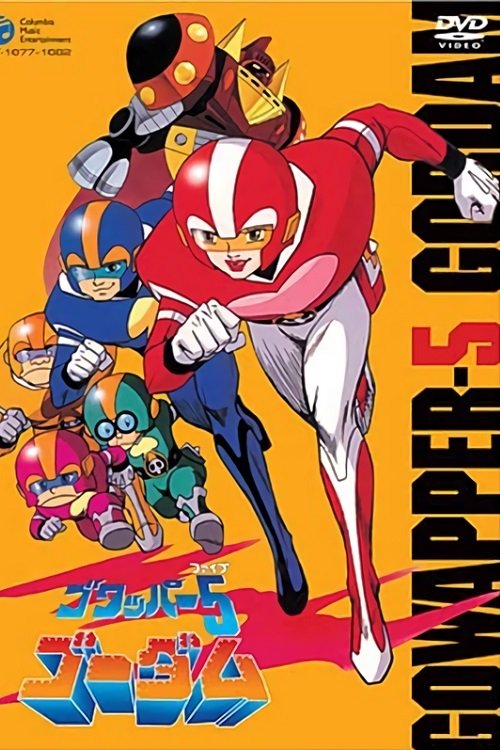 Gowappa 5 Gōdam (1976)
 Dennō Bōkenki Webdiver (2001)
 Getter Robo Go (1991)
 Great Dangaioh (2001)
 Kinkyū Hasshin Saver Kids (1991)
 GR: Giant Robo (2007)
- More like this series, on a shelf you can walk up to.It's the lit case on the top shelf.