Brave Command Dagwon (1996)

- Original title
- 勇者指令ダグオン
- Directed by
- Tomomi Mochizuki
- Genre
- mecha, Action, Adventure, Mecha
- Country
- Japan
- Length
- 1 season, 48 episodes
- Rating
- 9.0 of 10 from 4 voters
- Elsewhere
- IMDb

The catalogue in 3D
The film shelves have a room of their own that you can walk around in. The cat behind the counter is the AI Catbot, and they pick real films from the same catalogue when you tell them what you feel like watching. Nothing is for sale, here or in there. Go in from here and this series is already out on the counter, with more like it waiting on the shelf next to it.
How it feels
Alien prisoners escape from a space prison and attack Earth. An alien officer recruits five teenage boys who use wrist devices to transform into armored superheroes and fight the invaders.
energeticaction-packedlightheartednostalgicteam-orientedepisodictransformative
What happens
Brave Command Dagwon (Japanese: 勇者指令ダグオン, Hepburn: Yūsha Shirei Daguon) is a Japanese anime series begun in 1996, created and produced by Sunrise under the direction of Tomomi Mochizuki (who also wrote episodes for the show under the penname Go Sakamoto) and was the seventh and penultimate entry in the Brave (Yūsha) franchise. Earth is the target of the former Sargasso prisoners who seize control of Sargasso and attack our planet - to counter this, alien officer Brave Alien selects five (and then later seven as the series progresses) teenage boys from Earth to receive the wrist-worn DagCommanders that transform them into the series' title team, the human equivalent to "brave" warriors. Drawing inspiration from anime franchises which feature transforming heroes as well as anime stock footage hero transformation sequences like live-action tokusatsu franchises (e.g. Super Sentai and its Western counterpart Power Rangers), the selected teenage protagonists transform into special DagTector (ダグテクター, DaguTekutā) battle suits, by activating their DagCommanders' transformation function with the transformation call "Try Dagwon", which grant them pseudo-elemental powers and attacks as well as protection, weapons, tools and amplified physical power. If that is not enough, they have personal basic mecha at their disposal which can turn into humanoid forms as a part of Fusion Combination (融合合体, Yūgō Gattai), a process that sees a character (hero, villain, or otherwise) merge with their mecha not in the sense of a physical merger but in a style where the character transforms their body into anti-matter, like they became an illusion or ghost, and becomes an embodiment for their mecha's humanoid transformation, the mecha serving also as a way of assuming a mecha form. If even greater power is needed, the heroes can merge with additional support units (or perhaps each other) to strengthen their Fusion Combination transformations by forming a physical mecha combination. In addition to the title protagonists, other friendly beings soon arrive on Earth to aid their efforts of fighting Sargasso - for example: Gunkid, whose own transformations include a tank, jet or the hand-held Infinity Cannon (無限砲, Mugen Hō), was initially on Sargasso's side before he decides to support the Dagwon team, and Lian, a robot that transforms into a sword who later becomes Gunkid's teacher. The protagonists also have DagBase (ダグベース, DaguBēsu), a base which En, one of the Dagwon team's members, uses one ability of: Super Fusion Combination (超融合合体, Chō Yūgō Gattai), a form of Fusion Combination which is slightly stronger than the basic kind as a user assimilates DagBase, transforming themselves and DagBase into DagBase Robo (ダグベースロボ, DaguBēsu Robo). (from Wikipedia, CC BY-SA)
More like this
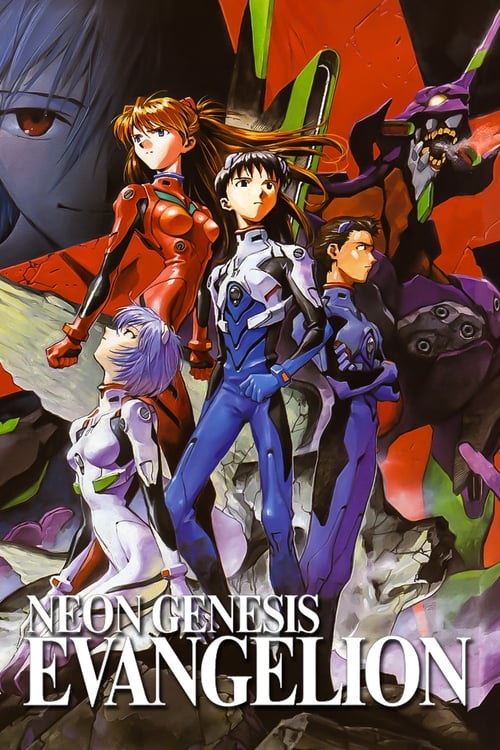 Neon Genesis Evangelion (1995)
 Raideen the Superior (1996)
 Chōdenji Robo Combattler V (1976)
 The Brave Fighter of Sun Fighbird (1991)
 Mechander Robo (1977)
 God Mars (1981)
 Dancouga – Super Beast Machine God (1985)
 Science Ninja Team Gatchaman (1972)
- More like this series, on a shelf you can walk up to.It's the lit case on the top shelf.