Extraterrestrial (2005)

- Genre
- documentary
- Country
- United Kingdom, United States
- Length
- 1 season, 2 episodes
- Rated
- TV-PG
- Rating
- 10.0 of 10 from 1 voters
- Elsewhere
- IMDb
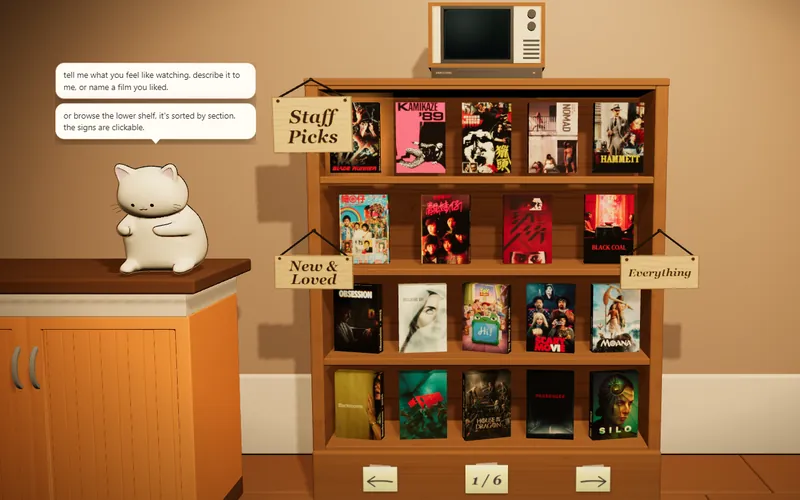
The catalogue in 3D
The film shelves have a room of their own that you can walk around in. The cat behind the counter is the AI Catbot, and they pick real films from the same catalogue when you tell them what you feel like watching. Nothing is for sale, here or in there. Go in from here and this series is already out on the counter, with more like it waiting on the shelf next to it.
How it feels
This two-part documentary speculates on what alien life might look like on two fictional exoplanets. Scientists use real biology and climate science to imagine creatures evolving on a tidally locked world and a large moon.
speculativeeducationalcontemplativewonder-filledgroundedscientificthought-provokingvisually imaginative
What happens
Extraterrestrial, also known in the UK as Alien Worlds, is a British-American two-part television documentary miniseries, aired in 2005 in the UK by Channel 4, by the National Geographic Channel in the US on Monday, May 30, 2005 and produced by Big Wave Productions Ltd. The program focuses on the hypothetical and scientifically feasible evolution of alien life on extrasolar planets, providing model examples of two different fictional worlds, one in each of the series's two episodes. The documentary is based on speculative collaboration of a group of American and British scientists, who were collectively commissioned by National Geographic. For the purposes of the documentary, the team of scientists divides two hypothetical examples of realistic worlds on which extraterrestrial life could evolve: A tidally locked planet (dubbed "Aurelia") orbiting a red dwarf star and a large moon (dubbed "Blue Moon") orbiting a gas giant in a binary star system. The scientific team of the series used a combination of accretion theory, climatology, and xenobiology to imagine the most likely locations for extraterrestrial life and most probable evolutionary path such life would take. The "Aurelia" and "Blue Moon" concepts seen in the series were also featured in the touring exhibition The Science of Aliens. (from Wikipedia, CC BY-SA)
More like this
 Planet Earth (2006)
 Alien Planet (2005)
 Alien Worlds (2020)
 Prehistoric Planet (2022)
 The Future Is Wild (2002)
 Year Million (2017)
 Into the Universe with Stephen Hawking (2010)
 How the Universe Works (2010)
- More like this series, on a shelf you can walk up to.It's the lit case on the top shelf.