Cosmos: A Spacetime Odyssey (2014)

- Original title
- Cosmos
- Directed by
- Bill Pope, Brannon Braga, Ann Druyan
- Genre
- documentary film, documentary television program
- Country
- United States
- Length
- 1 season, 13 episodes
- Rated
- TV-G
- Rating
- 8.5 of 10 from 1,689 voters
- Elsewhere
- IMDb
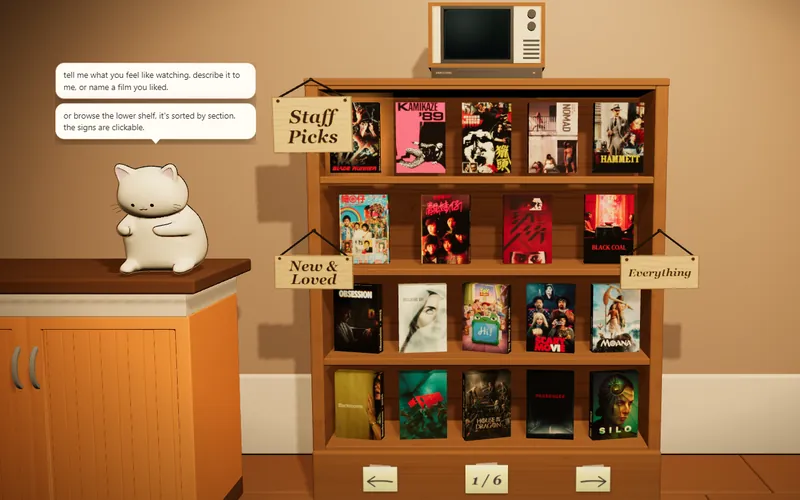
The catalogue in 3D
The film shelves have a room of their own that you can walk around in. The cat behind the counter is the AI Catbot, and they pick real films from the same catalogue when you tell them what you feel like watching. Nothing is for sale, here or in there. Go in from here and this series is already out on the counter, with more like it waiting on the shelf next to it.
How it feels
A science documentary series that explores the universe, natural history, and human understanding of our place in space. It is hosted by astrophysicist Neil deGrasse Tyson and builds on the legacy of the original 1980 series.
awe-inspiringeducationalhopefulcontemplativewonder-filledinformativevisually lushpaced
What happens
Cosmos: A Spacetime Odyssey is a 2014 American science documentary television series. The show is a follow-up to the 1980 television series Cosmos: A Personal Voyage, which was presented by Carl Sagan on the Public Broadcasting Service and is considered a milestone for scientific documentaries. This series was developed to bring back the foundation of science to network television at the height of other scientific-based television series and films. The show is presented by astrophysicist Neil deGrasse Tyson, who, as a young high school student, was inspired by Sagan. Among the executive producers are Seth MacFarlane, whose financial investment was instrumental in bringing the show to broadcast television, and Ann Druyan, a co-author and co-creator of the original television series and Sagan's widow. The show is produced by Brannon Braga, and Alan Silvestri composed the score. The series loosely follows the same thirteen-episode format and storytelling approach that the original Cosmos used, including elements such as the "Ship of the Imagination" and the "Cosmic Calendar", but features information updated since the 1980 series, along with extensive computer-generated graphics and animation footage augmenting the narration. The series premiered on March 9, 2014, simultaneously in the United States across ten 21st Century Fox networks. The remainder of the series aired on the Fox Network, with the National Geographic Channel rebroadcasting the episodes the next night with extra content. The series has been rebroadcast internationally in dozens of other countries by local National Geographic and Fox stations. The series concluded on June 8, 2014, with home media release of the entire series on June 10, 2014. Cosmos has been critically praised, winning several television broadcasting awards and a Peabody Award for educational content. A sequel series, Cosmos: Possible Worlds, premiered on March 9, 2020, on National Geographic. (from Wikipedia, CC BY-SA)
More like this
 Cosmos: Possible Worlds (2020)
 Cosmos: A Personal Voyage (1980)
 How the Universe Works (2010)
 The Universe (2007)
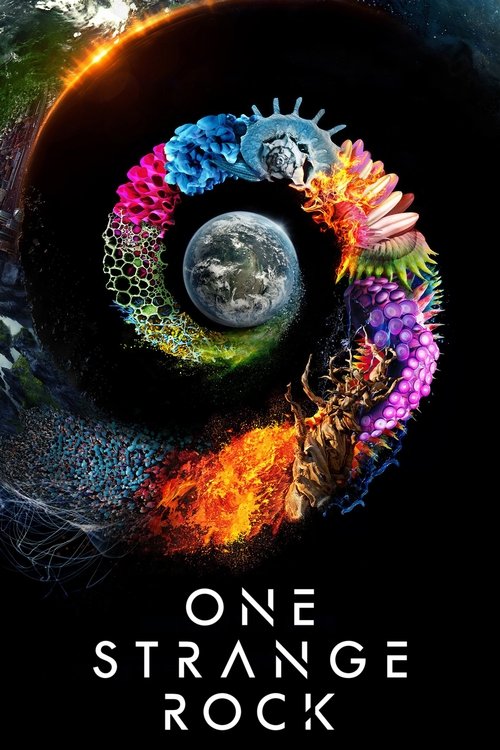 One Strange Rock (2018)
 Planet Earth II (2016)
 Space's Deepest Secrets (2016)
 StarTalk (2015)
- More like this series, on a shelf you can walk up to.It's the lit case on the top shelf.