Genji Tsūshin Agedama (1991)

- Original title
- ゲンジ通信あげだま
- Genre
- science fiction anime and manga, comedy anime and manga
- Country
- Japan
- Length
- 1 season, 51 episodes
- Rating
- 4.8 of 10 from 4 voters
- Elsewhere
- IMDb
The catalogue in 3D
The film shelves have a room of their own that you can walk around in. The cat behind the counter is the AI Catbot, and they pick real films from the same catalogue when you tell them what you feel like watching. Nothing is for sale, here or in there. Go in from here and this series is already out on the counter, with more like it waiting on the shelf next to it.
How it feels
A kid hero arrives on Earth in a Japanese city. He often fights a rich girl who is also a supervillainess. The show is full of jokes and nods to other anime, TV shows, and movies from its time.
parodiclightheartedenergeticplayfulnostalgicfast-pacedcomicreferential
What happens
Genji Tsūshin Agedama (ゲンジ通信あげだま) is a Japanese anime series created by Sukehiro Tomita and Akira Sakuma, produced by NAS and TV Tokyo, and animated by Studio Gallop. The series was broadcast on TV Tokyo every Friday evening from October 4, 1991, to September 25, 1992. It centers around a kid hero who comes down to Earth in a city in Japan and often battles the city's resident rich girl and supervillainess. The anime contains many of references and parodies from other anime series as well as live-action shows and movies that were popular at the time, e.g., Kiki's Delivery Service, Kamen Rider X, A Taxing Woman, and Sailor Moon (which had started airing a few months afterward, and Usagi Tsukino would be played by the same voice actress as the love interest of this show). Aside from the anime, two manga series and a PC Engine side-scrolling video game by NEC Home Electronics were made as tie-ins, all of which were also released in 1991. The first manga was written by Kazuhiko Shimamoto and was serialized in Deluxe BomBom, released a few months before the anime. This version followed an early draft that featured different scenarios and character designs to the ones shown in the anime and served as the basis for the video game. The second manga was written by Eiichi Saitō, which was published in Comic BomBom and followed the anime closely. (from Wikipedia, CC BY-SA)
More like this
 Time Bokan series
 Uchurei!
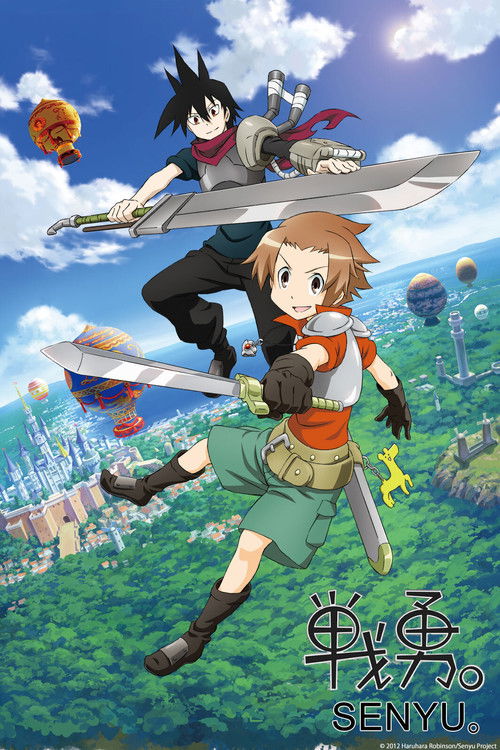 Senyu (2013)
 Dokkan! Robotendon
 Panda-Z (2004)
 Medabots (1997)
 Azur Lane: The Animation (2019)
 Dokachin the Primitive Boy
- More like this series, on a shelf you can walk up to.It's the lit case on the top shelf.