Popeye Playhouse

- Country
- United States
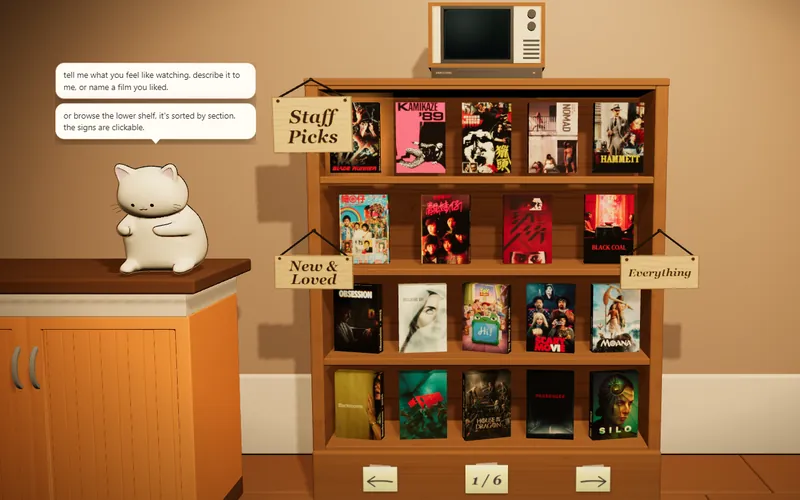
The catalogue in 3D
The film shelves have a room of their own that you can walk around in. The cat behind the counter is the AI Catbot, and they pick real films from the same catalogue when you tell them what you feel like watching. Nothing is for sale, here or in there. Go in from here and this series is already out on the counter, with more like it waiting on the shelf next to it.
How it feels
A children's show that aired weekday mornings in South Florida from 1957 to 1979. Skipper Chuck hosted the program, which featured stories, guests, silly stunts with puppets, and birthday announcements for kids.
whimsicalplayfulnostalgiclightheartedgentleeducationalquirkydown-to-earth
What happens
Popeye Playhouse is a children's television show which aired weekday mornings on the American television station WTVJ in South Florida from 1957 until 1979. It was hosted by its producer and announcer, Chuck Zink, who played the character Skipper Chuck. The show was built around life in the Playhouse, where the Skipper would tell stories, meet guests, and indulge in silly stunts with regular characters, both humans and puppets. This local children's show went on the air live in January 1957. Originally, the show was aired in an afternoon time slot from 5:00PM to 6:00PM, prior to Ralph Renick and the local news program. Popeye Playhouse had an audience of children who were primarily from Florida schools in Dade, Broward and Palm Beach counties. Skipper Chuck announced the birthdays of children, and he and his co-hosts frequently did a "Safety and Manners" program at regional elementary schools. The show moved to a videotape format sometime after 1958. Popeye Playhouse was then recorded at 4:00PM at the WTVJ Studios in downtown Miami, and broadcast the next weekday morning at 7:00AM. His show was radically impacted by the fact that Zink was from the north. Born in Indiana, with radio and TV experience in Pennsylvania, he rejected the separation of the races on the program when he found out children were booked in groups from schools which were not integrated. Zink demanded that management allow integration on his program. That happened in the late 1950s (possibly as early as 1958), and was prior to the 1960s when race relations became a national movement. When a child asked him what the two fingers up meant (the peace sign), he came up with a new symbol with three fingers up, to represent "Peace, Love, and Happiness". The symbol led to a song that would close the show. The show was cancelled in 1979. (from Wikipedia, CC BY-SA)
More like this
 The Children's Hour
 Young Seven
 Mr. Cartoon (1960)
 Desmond and the Channel 9-Pins (1957)
 The Candy Apple News Company
 Holiday Hotel
 Sailor Bob
 UPN Kids
- More like this series, on a shelf you can walk up to.It's the lit case on the top shelf.