The Big Time

- Genre
- documentary film, reality television
- Country
- United Kingdom
- Length
- 3 seasons, 15 episodes
- Elsewhere
- IMDb
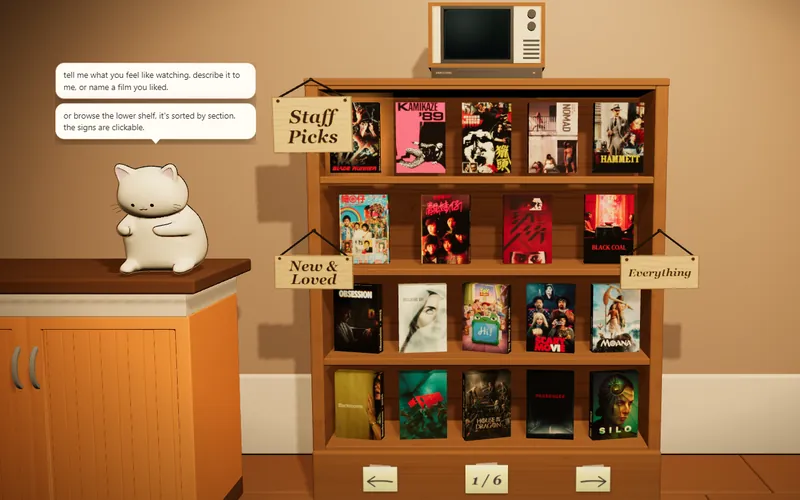
The catalogue in 3D
The film shelves have a room of their own that you can walk around in. The cat behind the counter is the AI Catbot, and they pick real films from the same catalogue when you tell them what you feel like watching. Nothing is for sale, here or in there. Go in from here and this series is already out on the counter, with more like it waiting on the shelf next to it.
How it feels
Ordinary British people get a chance to shine by pursuing a big ambition. Each episode follows one amateur as they receive expert coaching and try to succeed in a professional setting like conducting an orchestra or running a hotel kitchen.
observationalhopefulwholesomeearnestinformativedown-to-earthsupportivemildly dramatic
What happens
The Big Time was a British documentary and reality television series made by the BBC, consisting of 15 original episodes which ran from 1976 to 1980. A revised, extended repeat of episode 12 was broadcast in 1981. Devised and produced by Esther Rantzen and narrated initially by Rantzen but later by John Pitman, Paul Heiney and Norma Shepherd, each programme followed a member of the public placed in the limelight as a result of their skill and documenting how they fared. Their progress was filmed and sundry professionals in their fields advised the amateur as they progressed. Some of the exploits included an amateur musician conducting an orchestra at the Fairfield Halls; a housewife becoming a TV presenter; a cookery competition winner becoming head chef for the day at The Dorchester hotel and preparing a banquet lunch for former Prime Minister Edward Heath; an amateur wrestler taking on professional John Naylor on a bill at the Albert Hall on 26 March 1980 (the amateur was given the stage name 'Rip Rawlinson'); a model entering the Miss United Kingdom beauty contest; an amateur footballer (Lol Cottrell) being trained by Liverpool player Tommy Smith to take part in the latter's testimonial game; a young gymnast who became a circus trapeze artist; an amateur singer getting the chance to record a single. The latter 'discovered' the singer Sheena Easton (with a follow-up Big Time special episode airing a year later, after she achieved stardom) and the edition featuring the amateur chef is credited as terminating the television career of the TV chef Fanny Cradock, who criticised the amateur's choice of menu. When the series ended, the BBC commissioned In at the Deep End, which followed the same format only using two presenters, Chris Serle and erstwhile The Big Time reporter Paul Heiney (former reporters on Rantzen's That's Life!), as they undertook various tasks as complete beginners in professional roles. Further versions of the format followed, when Hale and Pace (comedians Gareth Hale and Norman Pace) presented a short-lived series Jobs for the Boys on BBC TV in 1997, where they undertook professional tasks as complete amateurs. The four episodes featured the pair attempting to become professional polo players, dress designers, producers of a TV commercial and an effort to write Britain's 1998 Eurovision Song Contest entry. This format followed 1995's Jobs for the Girls, when Birds of a Feather stars Pauline Quirke and Linda Robson undertook four similar tasks. (from Wikipedia, CC BY-SA)
More like this
 Book of Cool
 Video Diaries
 Only Human
 Educating (2011)
 Holidays in the Danger Zone
 The Hotel (2011)
 Extraordinary People (2003)
 How the Other Half Live (2009)
- More like this series, on a shelf you can walk up to.It's the lit case on the top shelf.