Jai Mahabharat

- Country
- India
- Elsewhere
- IMDb

The catalogue in 3D
The film shelves have a room of their own that you can walk around in. The cat behind the counter is the AI Catbot, and they pick real films from the same catalogue when you tell them what you feel like watching. Nothing is for sale, here or in there. Go in from here and this series is already out on the counter, with more like it waiting on the shelf next to it.
How it feels
This series adapts the ancient Indian epic the Mahabharata. It tells the story of a dynastic war between two groups of royal cousins, the Kauravas and the Pandavas. The narrative includes philosophical teachings and other classic tales from Hindu tradition.
epicsprawlingancientphilosophicalmythologicaldramaticmoralweighty
What happens
The Mahābhārata ( mə-HAH-BAR-ə-tə, MAH-hə-; Sanskrit: महाभारतम्, IAST: Mahābhāratam, pronounced [mɐɦaːˈbʱaːrɐt̪ɐm], 'Great Bharata') is one of the two major Sanskrit epics of ancient India revered in Hinduism, the other being the Ramayana. Both are smriti texts, and together they are known as the Itihasas. The Mahabharatha narrates the events before, during, and after the Kurukshetra War, a war of succession between two groups of princely cousins, the Kauravas and the Pāṇḍavas. It contains philosophical and devotional material, such as a discussion of the four "goals of life" or puruṣārtha (12.161). Among the principal works and stories in the Mahābhārata are the Bhagavad Gita, the story of Damayanti, Shakuntala, Pururava and Urvashi, Savitri and Satyavan, Kacha and Devayani, Rishyasringa and an abbreviated version of the Rāmāyaṇa. Traditionally, the authorship of the Mahābhārata is attributed to Vyāsa. There have been many attempts to unravel its historical growth and compositional layers. The bulk of the Mahābhārata was probably compiled between the 3rd century BCE and the 3rd century CE, with the oldest preserved parts not much older than around 400 BCE. The text probably reached its final form by the early Gupta period (c. 4th century CE). The title is translated as "Great Bharat (India)", or "the story of the great descendants of Bharata", or as "The Great Indian Tale". The Mahābhārata is one of the longest epic poems known. Its longest version consists of over 100,000 shlokas (verses) or over 200,000 individual lines (each shloka is a couplet), and long prose passages. At about 1.8 million words in total, the Mahābhārata is roughly ten times the length of the Iliad and the Odyssey combined, or about four times the length of the Rāmāyaṇa, albeit more than 2.5 times shorter than the world's longest poem, The Epic of Manas. Within the Indian tradition it is sometimes called the fifth Veda. (from Wikipedia, CC BY-SA)
More like this
 Mahabharat (2013)
 Ek Aur Mahabharat
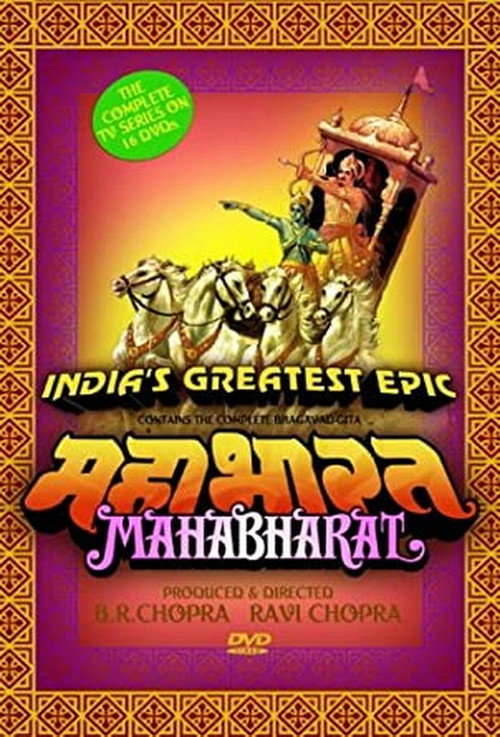 Mahabharat (1988)
 Kahaani Hamaaray Mahaabhaarat Ki (2008)
 Mahabharat Katha (1997)
 Kurukshetra: The Great War of Mahabharata
 Mrityunjay
 The Mahabharata (1989)
- More like this series, on a shelf you can walk up to.It's the lit case on the top shelf.