54th Street Revue

The catalogue in 3D
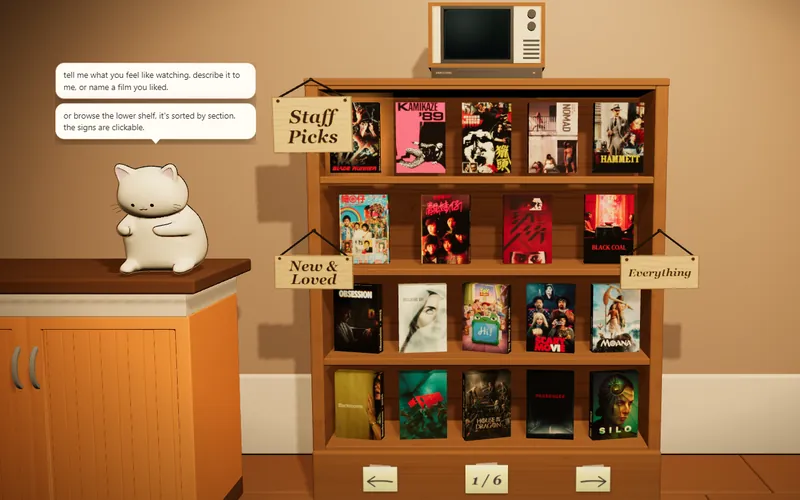
The film shelves have a room of their own that you can walk around in. The cat behind the counter is the AI Catbot, and they pick real films from the same catalogue when you tell them what you feel like watching. Nothing is for sale, here or in there. Go in from here and this series is already out on the counter, with more like it waiting on the shelf next to it.
How it feels
This is an early American variety show that gave stage time to new performers. It aired live from a New York theater with different hosts and a rotating cast of singers, dancers, and comedians.
nostalgiclivelyepisodicinformaldatedlightheartedbriskshowcasing
What happens
54th Street Revue is an American variety television program that was broadcast on CBS from May 5, 1949, through March 25, 1950. The program was a "showcase for up-and-coming professionals", originating from a theater on 54th Street in New York City. Hosts for 54th Street Revue included Jack Sterling, Al Bernie, Billy Vine, and Joey Faye. Regular performers on the program included Bambi Lynn, Annabel Lyons, Joe Silver, Pat Bright, Russell Arms, Marilyn Day, Cliff Tatum, Butch Cavell, Bob Fosse, Mort Marshall, Wynn Murray, and Carl Reiner The regular cast changed frequently as entertainers found other jobs "that were more substantial than employment in early television". Barry Wood was the executive producer, with Ralph Levy as director. Al Selden and Bill Scudder created original music and lyrics for the show. Writers included Alan Sands, Jess Kaplan, George Axelrod, Allan Sherman, and Max Wilk. Harry Sosnick directed the orchestra. The program initially was on Thursdays from 8 to 9 p.m. Eastern Time. In September 1949 it moved to Fridays from 9 to 10 p.m., ET, and in January 1950 it moved to Saturdays from 8 to 9 p.m. ET. Although the program was scheduled to end in late November 1949, its time on the air was extended "at least through Dec. 23". In late January 1950, its run was extended again on an alternate-weeks schedule as two advertising agencies showed interest in its "rising ratings and its low budget". A review in the February 1, 1950, issue of the trade publication Variety noted that the program's pace had "become too even and placid for its own good." (from Wikipedia, CC BY-SA)
More like this
 Tonight on Broadway
 Those Two
 The Chesterfield Supper Club (1956)
 Ford Star Revue
 The Lively Ones
 Cavalcade of Stars
 Holiday Hotel
 Ladies' Choice
- More like this series, on a shelf you can walk up to.It's the lit case on the top shelf.