The Way of the Eskimo (1911)

- Directed by
- William V. Mong
- Genre
- silent film
- Country
- United States
- Elsewhere
- IMDb

The catalogue in 3D
The film shelves have a room of their own that you can walk around in. The cat behind the counter is the AI Catbot, and they pick real films from the same catalogue when you tell them what you feel like watching. Nothing is for sale, here or in there. Go in from here and this film is already out on the counter, with more like it waiting on the shelf next to it.
How it feels
A silent drama that tells a love story set among Inuit people in Labrador. The film was shot in Michigan and is now lost with no known copies.
datedstagedromanticfrozengrainysilentlost
What happens
The Way of the Eskimo is a lost 1911 American silent drama film that portrayed the Inuit or "Eskimo" culture of northeastern Canada along the coast of Labrador. Directed by William V. Mong and produced by Selig Polyscope Company, this "photoplay" was based on a love story written by Columbia Eneutseak, a young Inuk woman who was born in the United States in 1893, in the "Esquimaux Village" exhibition at the World's Columbian Exposition in Chicago. She, fellow Inuk performer Zacharias Zad, and William Mong costarred in the film with a supporting cast that included members of Columbia's immediate family and other Inuit players. While this production was promoted in 1911 as being filmed on location in northern Canada, it was actually shot that year at the snow-covered port town of Escanaba, Michigan, along a frozen stretch of shoreline of Little Bay de Noc, which connects to Lake Michigan. No copies of the motion picture are listed among the holdings of major film repositories in the United States, Canada, the United Kingdom, or the European Union. It is therefore currently classified as lost. (from Wikipedia, CC BY-SA)
More like this
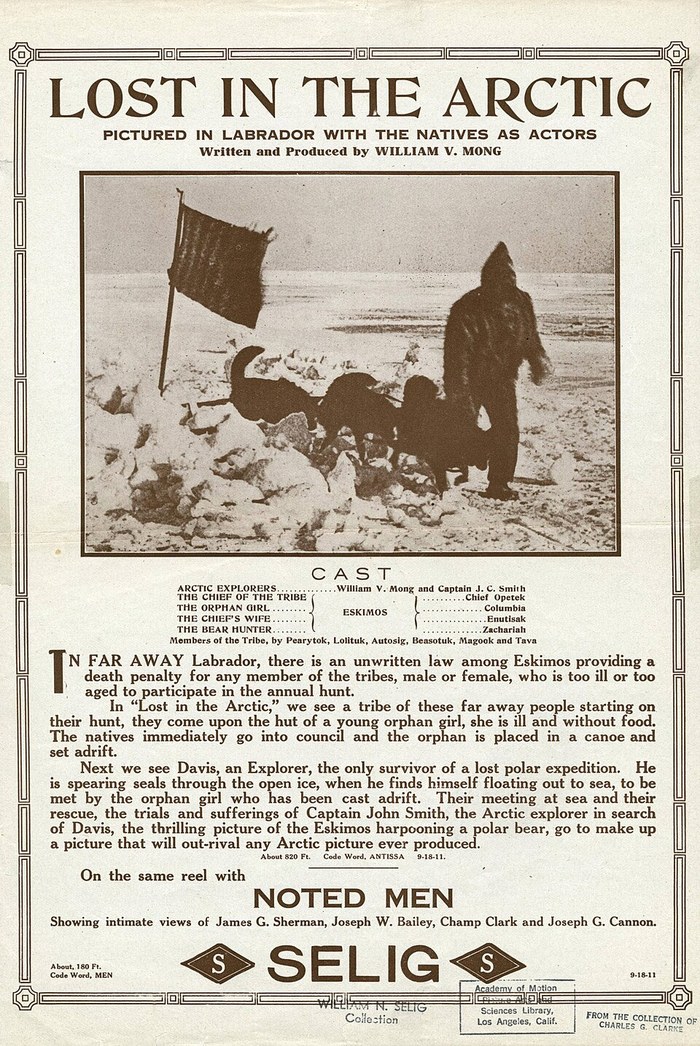 Lost in the Arctic (1911)
 Love in the Hills (1911)
 Sunshine Through the Dark (1911)
 In Old Florida (1911)
 Fisher Folks (1911)
 The O'Neill (1911)
 The Rosary (1911)
 The White Rose of the Wilds (1911)
- More like this film, on a shelf you can walk up to.It's the lit case on the top shelf.