Raja Harishchandra (1913)
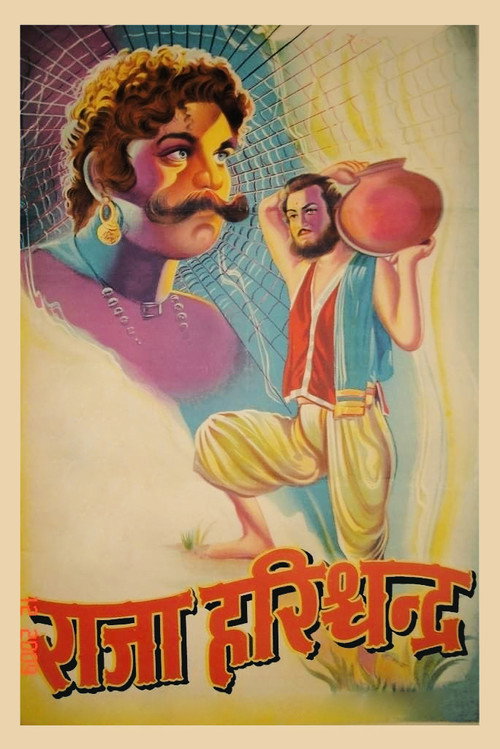
- Original title
- राजा हरिश्चंद्र
- Directed by
- Dadasaheb Phalke
- Genre
- fantasy film, silent film
- Country
- British Raj
- Runtime
- 40 min
- Rating
- 5.0 of 10 from 14 voters
- Elsewhere
- IMDb
The catalogue in 3D
The film shelves have a room of their own that you can walk around in. The cat behind the counter is the AI Catbot, and they pick real films from the same catalogue when you tell them what you feel like watching. Nothing is for sale, here or in there. Go in from here and this film is already out on the counter, with more like it waiting on the shelf next to it.
How it feels
This 1913 silent film tells the story of the legendary king Harishchandra, a ruler known for his unwavering commitment to truth. It follows his trials and sacrifices as he upholds his principles despite losing his kingdom and family.
mythologicalsilentpioneeringstatelyausteredevotionalantique
What happens
Raja Harishchandra (transl. King Harishchandra) is a 1913 Indian silent film directed and produced by Dadasaheb Phalke. It is often considered the first full-length Indian feature film. Raja Harishchandra features Dattatraya Damodar Dabke, Anna Salunke, Bhalchandra Phalke and Gajanan Vasudev Sane. It is based on the legend of Harishchandra, with Dabke portraying the title character. The film, being silent, had English, Marathi, and Hindi-language intertitles. Phalke decided to make a feature film after watching The Life of Christ (1906) at a theatre in Bombay in April 1911. In February 1912, he went to London for two weeks to learn filmmaking techniques and upon return founded Phalke Films Company. He imported the hardware required for filmmaking and exhibition from England, France, Germany, and the United States. Phalke shot a short film Ankurachi Wadh (Growth of a Pea Plant) to attract investors for his venture. He published advertisements in various newspapers calling for the cast and crew. As no women were available to play female roles, male actors performed the female roles. Phalke was in charge of scriptment, direction, production design, make-up, film editing, along with film processing. Trymbak B. Telang handled the camera. Phalke completed filming in six months and 27 days producing a film of 3,700 feet (1,100 m), about four reels. The film premiered at the Olympia Theatre, Bombay, on 21 April 1913, and had its theatrical release on 3 May 1913 at the Coronation Cinematograph and Variety Hall, Girgaon. It was a commercial success and laid the foundation for the film industry in the country. The film is partially lost; only the first and last reels of the film are preserved at the National Film Archive of India. Some film historians believe these belong to a 1917 remake of the film by Phalke titled Satyavadi Raja Harishchandra. The status of Raja Harishchandra as the first full-length Indian feature film has been debated. Some film historians consider Dadasaheb Torne's silent film Shree Pundalik, released on 18 May 1912, the maiden Indian film. The Government of India, however, recognises Raja Harishchandra as the first Indian feature film. (from Wikipedia, CC BY-SA)
More like this
 Satyavadi Raja Harishchandra (1917)
 Samboorna Harichandra (1932)
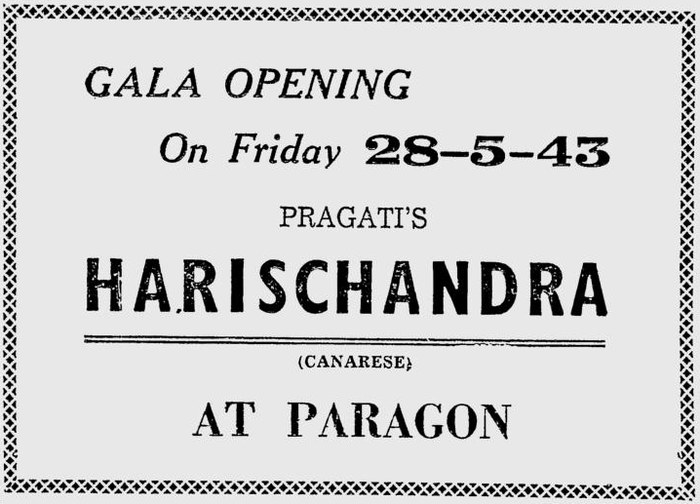 Satya Harishchandra (1943)
 Harichandra (1944)
 Satya Harishchandra (1965)
 Ayodhyecha Raja (1932)
 Mohini Bhasmasur (1913)
 Satyawadi Raja Harishchandra (1917)
- More like this film, on a shelf you can walk up to.It's the lit case on the top shelf.