Cabiria (1914)
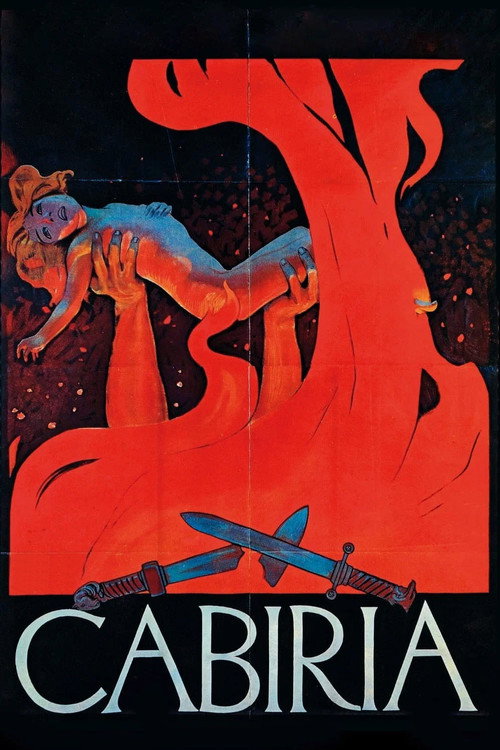
- Directed by
- Giovanni Pastrone
- Genre
- drama film, silent film, war film, classical antiquity film, adventure film
- Country
- Kingdom of Italy
- Runtime
- 3h
- Rated
- M/12
- Rating
- 7.1 of 10 from 143 voters
- Elsewhere
- IMDb
The catalogue in 3D
The film shelves have a room of their own that you can walk around in. The cat behind the counter is the AI Catbot, and they pick real films from the same catalogue when you tell them what you feel like watching. Nothing is for sale, here or in there. Go in from here and this film is already out on the counter, with more like it waiting on the shelf next to it.
How it feels
This Italian silent film is set during the Second Punic War. It follows a young girl named Cabiria who is kidnapped and experiences events like the eruption of Mount Etna and Hannibal's trek. The story includes battles and religious rituals in ancient Carthage.
epichistoricalgrandmelodramaticslow-pacedsilentvisual spectacledramatic
What happens
Cabiria is a 1914 Italian epic silent film, directed by Giovanni Pastrone and shot in Turin. The film is set in ancient Sicily, Carthage, and Cirta during the period of the Second Punic War (218–202 BC). It follows the story of an abducted little girl, Cabiria, and features an eruption of Mount Etna, religious rituals in Carthage, the alpine trek of Hannibal, Archimedes' defeat of the Roman fleet at the Siege of Syracuse and Scipio maneuvering in North Africa. Apart from being a classic on its own terms, the film is also notable for being the first film in which the long-running film character Maciste makes his debut. According to Martin Scorsese, in this work Pastrone invented the epic movie and deserves credit for many of the innovations often attributed to D.W. Griffith and Cecil B. DeMille. Among those was the extensive use of a moving camera, thus freeing the feature-length narrative film from "static gaze". The historical background and characters in the story are taken from Livy's Ab Urbe Condita (written ca. 27–25 BC). In addition, the script of Cabiria was partially based on Gustave Flaubert's 1862 novel Salammbô and Emilio Salgari's 1908 novel Cartagine in fiamme (Carthage in Flames). It was the first film shown at the White House, having been viewed on the South Lawn, by the President, First Lady, Vice President, his wife, members of the Cabinet and their wives, due to the summer heat in June 1914. (from Wikipedia, CC BY-SA)
More like this
 Quo Vadis (1913)
 Julius Caesar (1914)
 Salambo (1914)
 Madame Guillotine (1916)
 Antony and Cleopatra (1913)
 Fiorenza mia! (1915)
 The Last Days of Pompeii (1908)
 Agrippina (1910)
- More like this film, on a shelf you can walk up to.It's the lit case on the top shelf.