Lucrezia Borgia (1922)
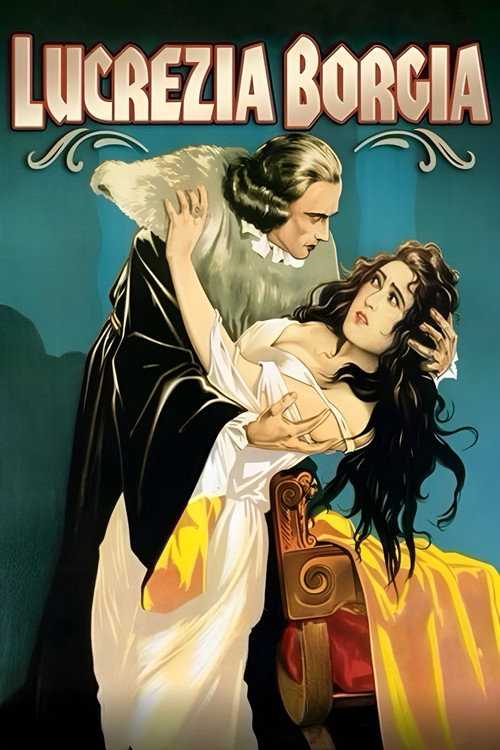
- Directed by
- Richard Oswald
- Genre
- drama film, silent film, adventure film, war film, historical film
- Country
- Germany
- Runtime
- 1h 36m
- Rating
- 5.1 of 10 from 8 voters
- Elsewhere
- IMDb

The catalogue in 3D
The film shelves have a room of their own that you can walk around in. The cat behind the counter is the AI Catbot, and they pick real films from the same catalogue when you tell them what you feel like watching. Nothing is for sale, here or in there. Go in from here and this film is already out on the counter, with more like it waiting on the shelf next to it.
How it feels
This silent historical film shows the corrupt and violent Borgia family during the Italian Renaissance. Cesare Borgia seduces his own cousin Lucrezia and murders his brothers in a quest for pleasure and power.
melodramaticlushdarkbleaksensationaltheatricalpacing-variablegrim
What happens
Lucrezia Borgia is a 1922 German silent historical film directed by Richard Oswald and starring Conrad Veidt, Liane Haid, Paul Wegener, and Albert Bassermann. It was based on a novel by Harry Sheff, and portrayed the life of the Renaissance Italian aristocrat Lucrezia Borgia (1480–1519). Botho Hoefer and Robert Neppach worked as the film's art directors, designing the period sets needed. It was shot at the Tempelhof Studios in Berlin. Karl Freund was one of the cinematographers. Famed French director Abel Gance remade the film in 1935. Cesare Borgia (Veidt) is a monstrous villain who will do anything for pleasure and power, even seducing his own cousin Lucrezia (Haid) and murdering his male siblings. The Borgias were a medieval family known for their corruption under the rule of Pope Alexander VI. Lucrezia Borgia changed real life siblings Cesare and Lucrezia Borgia into cousins, with Cesare and Juan referred to as "the nephew(s) of the Pope", not his sons. This film version made Lucrezia a more sympathetic character, blaming Cesare for causing her indiscretions. Director Richard Oswald's depiction of the family was seen as an attack on the Catholic Church, thus the film was not able to be shown in the U.S. until 1928, and even then the American prints were edited down to 75 minutes. Richard Oswald directed a number of classic horror films, including The Picture of Dorian Gray (1917), Eerie Tales (1919), The Hound of the Baskervilles (1914-1915), and Uncanny Stories (1932), a remake of the 1919 film. Conrad Veidt and Paul Wegener were in the cast. Actor William Dieterle later moved to Hollywood where he directed the Charles Laughton version of The Hunchback of Notre Dame in 1939. (from Wikipedia, CC BY-SA)
More like this
 The Night of the Medici (1922)
 The Betrothed (1922)
 Monna Vanna (1922)
 Dante nella vita e nei tempi suoi (1922)
 The Count of Charolais (1922)
 For Love and Crown (1922)
 I due sergenti (1922)
 Luise Millerin (1922)
- More like this film, on a shelf you can walk up to.It's the lit case on the top shelf.