Terezin: A Documentary Film from the Jewish Settlement Area (1944)

- Original title
- Theresienstadt
- Directed by
- Karel Pecený, Kurt Gerron
- Genre
- propaganda film
- Country
- Nazi Germany
- Runtime
- 20 min
- Rating
- 3.0 of 10 from 7 voters
- Elsewhere
- IMDb

The catalogue in 3D
The film shelves have a room of their own that you can walk around in. The cat behind the counter is the AI Catbot, and they pick real films from the same catalogue when you tell them what you feel like watching. Nothing is for sale, here or in there. Go in from here and this film is already out on the counter, with more like it waiting on the shelf next to it.
How it feels
This is a Nazi propaganda film shot at the Theresienstadt concentration camp. It shows staged scenes of Jews living comfortably to counter reports of genocide. The film was directed by a Jewish prisoner under SS supervision and was meant to deceive the outside world.
propagandisticstageddeceptiveunsettlinghistoricalsomberbleakforced
What happens
Theresienstadt. Ein Dokumentarfilm aus dem jüdischen Siedlungsgebiet ("Theresienstadt: A Documentary Film from the Jewish Settlement Area"), unofficially Der Führer schenkt den Juden eine Stadt ("The Führer Gives a City to the Jews"), is a black-and-white projected Nazi propaganda film. It was directed by the German Jewish prisoner Kurt Gerron and the Czech filmmaker Karel Pečený under close SS supervision in the Theresienstadt concentration camp, and edited by Pečený's company, Aktualita. Filmed mostly in the autumn of 1944, it was completed on 28 March 1945 and screened privately four times. After the war, the film was lost but about twenty minutes of footage was later rediscovered in various archives. Unlike other Nazi propaganda films, which were under the control of Joseph Goebbels' Ministry of Propaganda, Theresienstadt was conceived and paid for by the Jewish Affairs department of the Protectorate of Bohemia and Moravia at the initiative of Hans Günther. The film, which displayed supposedly happy and healthy Jews, was part of a larger Nazi program to use Theresienstadt as a tool to discredit reports of the genocide of Jews reaching the Western Allies and neutral countries. However, it was not widely distributed and did not have the opportunity to influence public opinion. (from Wikipedia, CC BY-SA)
More like this
 Panorama (1944)
 Young Eagles (1944)
 Death Mills (1945)
 The Soviet Paradise (1942)
 Erbkrank (1935)
 Das Leben geht weiter (1944)
 The Red Terror (1942)
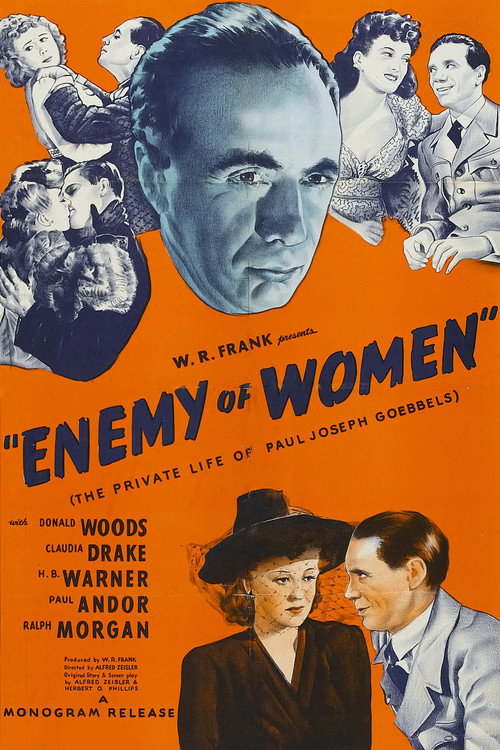 Enemy of Women (1944)
- More like this film, on a shelf you can walk up to.It's the lit case on the top shelf.