The Atom Strikes! (1945)
- Genre
- propaganda film
- Country
- United States
- Runtime
- 31 min
- Rating
- 5.9 of 10 from 7 voters
- Elsewhere
- IMDb

The catalogue in 3D
The film shelves have a room of their own that you can walk around in. The cat behind the counter is the AI Catbot, and they pick real films from the same catalogue when you tell them what you feel like watching. Nothing is for sale, here or in there. Go in from here and this film is already out on the counter, with more like it waiting on the shelf next to it.
How it feels
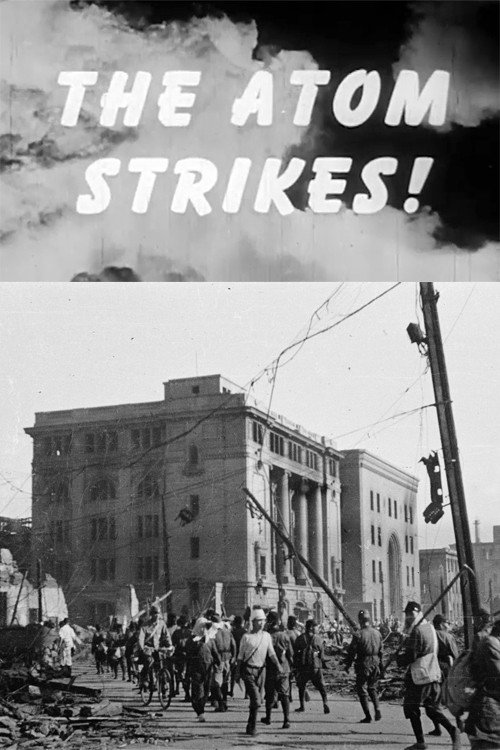
This documentary was made by the U.S. Army after World War II ended. It shows the damage from the atomic bombs in Hiroshima and Nagasaki. The film includes a priest's firsthand account of the bombing.
clinicaldetachedfactualsobereducationalstarkofficialdry
What happens
The Atom Strikes! is a documentary commissioned by the U.S. Army Signal Corps Pictorial Division shortly after the end of the Second World War. It documents the findings of a commission sent to Japan to assess the damage caused by the atomic bombing of Hiroshima and Nagasaki. Opening with the blast of the experimental bombing in Los Alamos, New Mexico in July 1945, the film turns to the Enola Gay and its mission over the Japanese city of Hiroshima. The narrator informs the audience about the military significance of the city and that it had not experienced bombing as yet, but it had been warned. The results of the bombing are then explained, with footage and descriptions of how various buildings were affected by the blast at different distances from ground zero. Afterwards, an interview with Father John A. Siemes, a Jesuit priest who was living at the Novitiate of the Society of Jesus in Nagatsuka, is shown to give the audience a firsthand account of the bombing. Near the end of the interview, the priest is seen reading from a prepared statement. Nagasaki is then mentioned, with the narrator pointing out how much armament and other military supplies were being produced there, as well as the fact that even civilian homes were used for war work. Nevertheless, the effect of the atomic blast on local schools and churches is also shown. (from Wikipedia, CC BY-SA)
More like this
 A Tale of Two Cities (1946)
 Death Mills (1945)
 Hiroshima Nagasaki August, 1945 (1970)
 Appointment in Tokyo (1945)
 Welt im Film No. 5 (1945)
 Nazi Concentration Camps (1945)
 The Last Bomb (1945)
 D-Day -1 (1945)
- More like this film, on a shelf you can walk up to.It's the lit case on the top shelf.