A Tale of Two Cities (1946)

- Original title
- Tale of Two Cities
- Genre
- propaganda film
- Country
- United States
- Runtime
- 12 min
- Rating
- 7.0 of 10 from 1 voters
- Elsewhere
- IMDb

The catalogue in 3D
The film shelves have a room of their own that you can walk around in. The cat behind the counter is the AI Catbot, and they pick real films from the same catalogue when you tell them what you feel like watching. Nothing is for sale, here or in there. Go in from here and this film is already out on the counter, with more like it waiting on the shelf next to it.
How it feels
This documentary recounts the atomic bombings of Hiroshima and Nagasaki in 1945. It shows the bomb tests, the targeting of military industrial sites, and interviews with survivors. The film also describes the American warning to Japan and ends with a somber reflection on nuclear power.
sobermatter-of-facthistoricalunnervingfactualawe-inspiringgriminstructive
What happens
A Tale of Two Cities is a 1946 propaganda/documentary film about the atomic bombings of Hiroshima and Nagasaki, produced by the Army-Navy Screen Magazine and numbered 76 on its catalog. The film describes chronologically, and for the most part, dispassionately, the testing and the use of the atomic bombs impact on Hiroshima, describing where the bomb was actually dropped, and the damage done to military industrial targets, as well as noting which edifices sustained less damage, like those built with reinforced concrete. An interview is shown with a Jesuit priest, who describes his experience, and notes that he believes that approximately 100,000 people died. Then the film moves on to Nagasaki, telling the audience that U.S. President Harry S. Truman warned the Japanese that he would use more nuclear weapons if they didn't surrender. The Nagasaki mission is described, showing the two plants that were the basic targets, and the valley that they planned to bomb, and then shows the mushroom cloud, "the funeral pyre of an aggressor nation". At the end, the film takes a sober view of the future of atomic power, showing an "atomic shadow" of someone in the Hiroshima blast, saying that this could be someone of any race or creed, and that the future of atomic power could help mankind, or destroy it, depending on how people use it. (from Wikipedia, CC BY-SA)
More like this
 The Effects of the Atomic Bomb on Hiroshima and Nagasaki (1946)
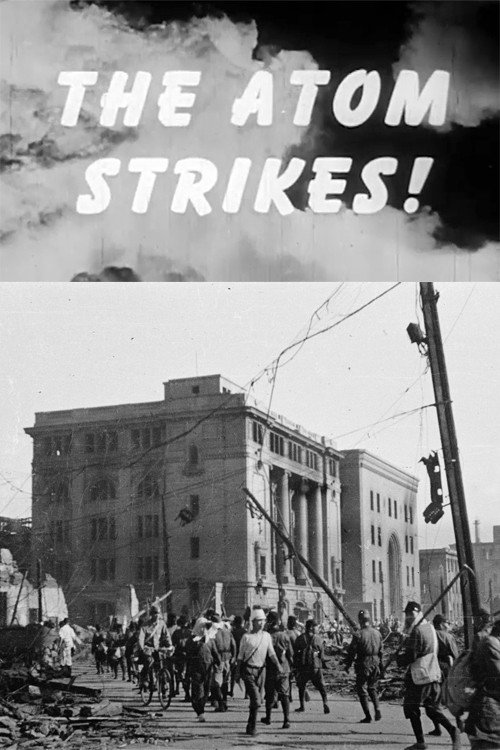 The Atom Strikes! (1945)
 Atomic Power (1946)
 One World or None (1946)
 Hiroshima Nagasaki August, 1945 (1970)
 Hellfire: A Journey from Hiroshima (1986)
 Special Delivery (1946)
 The Last Bomb (1945)
- More like this film, on a shelf you can walk up to.It's the lit case on the top shelf.