Rashomon (1950)

- Original title
- 羅生門
- Directed by
- Akira Kurosawa
- Genre
- drama film, samurai cinema, crime film, medieval film, flashback film
- Country
- Japan
- Runtime
- 1h 28m
- Rated
- NR
- Rating
- 8.0 of 10 from 2,541 voters
- Elsewhere
- IMDb
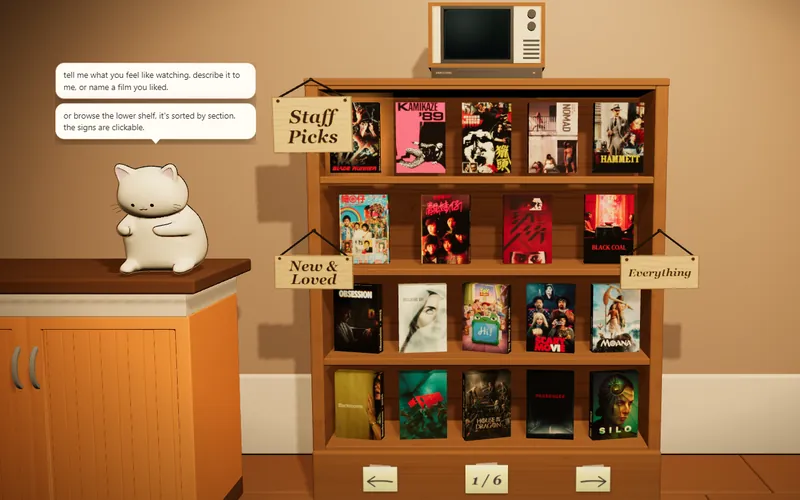
The catalogue in 3D
The film shelves have a room of their own that you can walk around in. The cat behind the counter is the AI Catbot, and they pick real films from the same catalogue when you tell them what you feel like watching. Nothing is for sale, here or in there. Go in from here and this film is already out on the counter, with more like it waiting on the shelf next to it.
How it feels
Several people give conflicting accounts of a samurai's murder in a forest. Each version reveals how the witnesses and participants lie to make themselves look better.
unreliabletensepsychologicalbleakcerebralatmosphericmeditativeambiguous
What happens
Rashomon (Japanese: 羅生門, Hepburn: Rashōmon) is a 1950 Japanese jidaigeki (period drama) psychological thriller film directed by Akira Kurosawa from a screenplay he co-wrote with Shinobu Hashimoto. Starring Toshiro Mifune, Machiko Kyō, Masayuki Mori, and Takashi Shimura, it follows various people who describe how a samurai was murdered in a forest. The plot and characters are based upon Ryūnosuke Akutagawa's short story "In a Grove", with the title and framing story taken from Akutagawa's "Rashōmon". Every element is largely identical, from the murdered samurai speaking through a Shinto psychic to the bandit in the forest, the monk, the assault of the wife, and the dishonest retelling of the events in which everyone shows their ideal self by lying. Production began in 1948 at Kurosawa's regular production firm Toho but was canceled as it was viewed as a financial risk. Two years later, Sōjirō Motoki pitched Rashomon to Daiei Film upon the completion of Kurosawa's Scandal. Daiei initially turned it down but eventually agreed to produce and distribute the film. Principal photography lasted from July 7 to August 17, 1950, taking place primarily in Kyoto on an estimated ¥15–20 million budget. When creating the film's visual style, Kurosawa and cinematographer Kazuo Miyagawa experimented with various methods such as pointing the camera at the sun, which was considered taboo. Post-production took only one week. Rashomon premiered at the Imperial Theatre on August 25, 1950, and was distributed throughout Japan the following day, to moderate commercial success, becoming Daiei's fourth highest-grossing film of 1950. Japanese critics praised the experimental direction and cinematography but criticized its adapting of Akutagawa's story and complexity. Upon winning the Golden Lion at the 12th Venice International Film Festival, Rashomon became the first Japanese film to attain significant international reception, garnering critical acclaim and earning roughly $800,000 abroad. It later won Best Foreign Language Film at the 24th Academy Awards, and was nominated for Best Film at the 6th British Academy Film Awards. Rashomon is now considered one of the greatest films ever made and among the most influential movies from the 20th century. It pioneered the Rashomon effect, a plot device that involves various characters providing subjective, alternative, and contradictory versions of the same incident. In 1999, critic Andrew Johnston asserted that "the film's title has become synonymous with its chief narrative conceit". (from Wikipedia, CC BY-SA)
More like this
 Harakiri (1962)
 Seven Samurai (1954)
 Samurai Assassin (1965)
 Bōryoku no Machi (1950)
 当り矢金八捕物帖 千里の虎 (1950)
 Bloody Spear at Mount Fuji (1955)
 13 Assassins (2010)
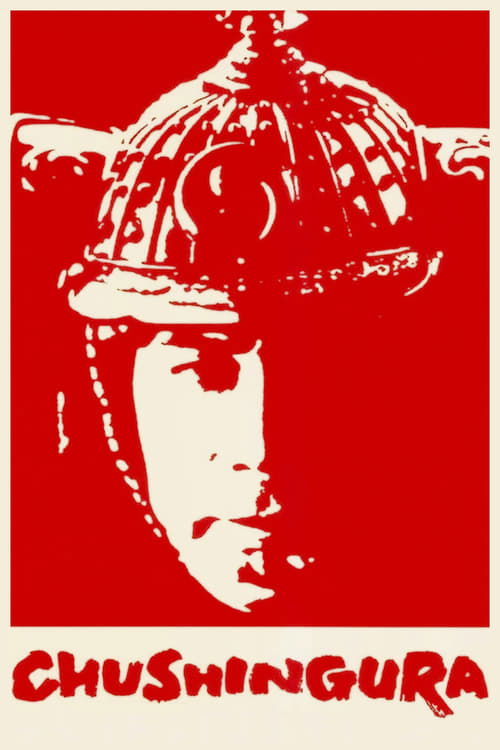 Chūshingura: Hana no Maki, Yuki no Maki (1962)
- More like this film, on a shelf you can walk up to.It's the lit case on the top shelf.