Seven Samurai (1954)

- Original title
- 七人の侍
- Directed by
- Akira Kurosawa
- Genre
- drama film, samurai cinema, action film, adventure film, epic film, historical drama
- Country
- Japan
- Runtime
- 3h 27m
- Rated
- NR
- Rating
- 8.4 of 10 from 4,279 voters
- Elsewhere
- IMDb
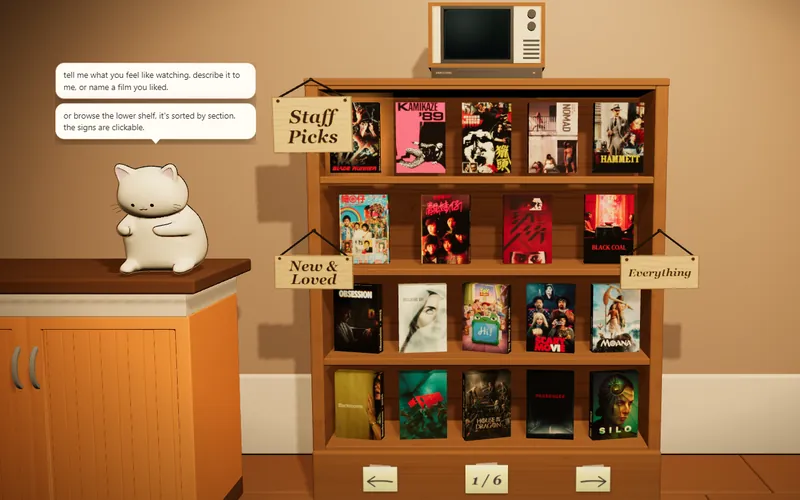
The catalogue in 3D
The film shelves have a room of their own that you can walk around in. The cat behind the counter is the AI Catbot, and they pick real films from the same catalogue when you tell them what you feel like watching. Nothing is for sale, here or in there. Go in from here and this film is already out on the counter, with more like it waiting on the shelf next to it.
How it feels
A farming village hires seven samurai to protect their crops from returning bandits. The defenders train the farmers and prepare for a final battle.
epicslow-burnintensedeterminedgrittyheroicemotionalmethodical
What happens
Seven Samurai (Japanese: 七人の侍, Hepburn: Shichinin no Samurai) is a 1954 Japanese epic jidaigeki film directed by Akira Kurosawa from a screenplay co-written with Shinobu Hashimoto and Hideo Oguni. Starring Toshirō Mifune, Takashi Shimura, Keiko Tsushima and Yukiko Shimazaki, it tells the story of a village of farmers who hire seven samurai to help defend their village from bandits who will return after the harvest to steal their crops. Influential in world cinema, Seven Samurai is considered to be one of the greatest films ever made. Kurosawa and Hashimoto researched the Edo period for stories to adapt and came across an account of samurai defending farmers from bandits. Together with Oguni, the screenwriters spent over six weeks writing the script and creating detailed plans for each of the film's characters. Produced by Toho, the film spent three months in pre-production casting and location scouting. Filming began on May 27, 1953 and took place on set at Toho Studios, and on location in Shizuoka and Kanagawa Prefectures. Mid-way through production, the film ran out of money. Toho eventually funded Samurai to a total of ¥210 million, making it the most expensive Japanese film made at the time. For the film's final battle, Kurosawa innovated the use of a multi-camera setup and telephoto lenses to adjust audience perception. Filming wrapped in 1954 after 148 working days. Seven Samurai was released in Japan on April 26, 1954, with a runtime of 207 minutes. The film was recut before entering the Venice Film Festival. At Venice, Kurosawa won the Silver Lion for direction, and the film was distributed in the United States by Columbia Pictures in November 1956, where it was recut again. The film grossed ¥290 million in ticket sales in Japan making it the highest-grossing film of that year, though due to its large production cost, it was not highly profitable. In the United States, the film grossed $145,800 in 1956 and 1957. The film received a mixed critical response in Japan, but a generally positive response in the US. Reviewers praised the story and acting but criticized the film's length and attitude towards the farmers. American reviews compared the film to Western movies. Samurai was nominated for two Academy Awards and three BAFTAs, but won none. In the decades since its release, scholars and reviewers have praised the film as a masterpiece. Seven Samurai has been influential among Western filmmakers, with its story and approach to action remade and reiterated numerous times, most notably in the 1960 film The Magnificent Seven. Seven Samurai also influenced other media, including anime and video games. Scholarly analysis of the film has looked at it through a humanistic and formalistic lens. Discussions focus on the morality and heroism of the samurai, showing their relationship to class and the environment. In addition to allegorical readings, scholars have also looked at the film's cinematography, use of music, and Seven Samurai's place within the jidaigeki genre. (from Wikipedia, CC BY-SA)
More like this
 Samurai I: Musashi Miyamoto (1954)
 Rashomon (1950)
 Harakiri (1962)
 Three Outlaw Samurai (1964)
 Akō gishi (1954)
 13 Assassins (2010)
 The Young Swordsman (1954)
 Merciless Blade (1953)
- More like this film, on a shelf you can walk up to.It's the lit case on the top shelf.