Aparajito (1956)

- Original title
- অপরাজিত
- Directed by
- Satyajit Ray
- Genre
- drama film, coming-of-age film
- Country
- India
- Runtime
- 1h 45m
- Rated
- 12
- Rating
- 7.9 of 10 from 294 voters
- Elsewhere
- IMDb

The catalogue in 3D
The film shelves have a room of their own that you can walk around in. The cat behind the counter is the AI Catbot, and they pick real films from the same catalogue when you tell them what you feel like watching. Nothing is for sale, here or in there. Go in from here and this film is already out on the counter, with more like it waiting on the shelf next to it.
How it feels
A boy grows from childhood into a college student as his family moves to Varanasi. The film follows Apu's emotional journey with his mother through his early education and coming of age.
melancholicslow-burntenderintrospectivebittersweetgroundedearnestpoignant
What happens
Aparajito (pronounced [ɔpɔradʒito] Ôporajito; The Unvanquished) is a 1956 Indian Bengali-language drama film written and directed by Satyajit Ray, and is the second part of The Apu Trilogy. It is an adaptation of the last part of Bibhutibhushan Bannerjee's novel Pather Panchali and the first part of his followup novel Aparajito. The film starts off where the previous film Pather Panchali (1955) ended, with Apu's family moving to Varanasi, and chronicles Apu's life from childhood to adolescence in college. When Ray started making Pather Panchali, he had no plans of following it up with a sequel, but the critical and commercial success of that film prompted him to start making Aparajito. Unlike his previous venture, where he stayed faithful to the novel, Ray took some bold artistic decisions here, such as portraying the relationship between Apu and his mother in a very different manner from the book. As a result, in contrast to its predecessor, the film was not received well locally; Ray recalled that "as for the suburban audience, it was shocked by the portrayal of the mother and son relationship, so sharply at variance with the conventional notion of mutual sweetness and devotion". Critical reception outside of India, however, was overwhelmingly positive. The film won 11 international awards, including the Golden Lion and Critics Award at the Venice Film Festival, becoming the first film to ever win both awards. Veteran film-maker Mrinal Sen said he considered Aparajito to be one of the best Indian movies he had ever seen. Bosley Crowther wrote that "it is done with such rare feeling and skill at pictorial imagery, and with such sympathetic understanding of Indian character on the part of Mr. Ray, that it develops a sort of hypnotism for the serene and tolerant viewer". The critical acclaim this movie received encouraged Ray to make another sequel, Apur Sansar (1959), which was equally well received, and thus concluded one of the most critically acclaimed movie trilogies of all time, as Roger Ebert later pointed out: "The three films ... swept the top prizes at Cannes, Venice and London, and created a new cinema for India – whose prolific film industry had traditionally stayed within the narrow confines of swashbuckling musical romances. Never before had one man had such a decisive impact on the films of his culture". (from Wikipedia, CC BY-SA)
More like this
 Apur Sansar (1959)
 Pather Panchali (1955)
 Vazhvile Oru Naal (1956)
 Muddu Bidda (1956)
 Era Bator Sur (1956)
 Toofan Aur Deeya (1956)
 Trijama (1956)
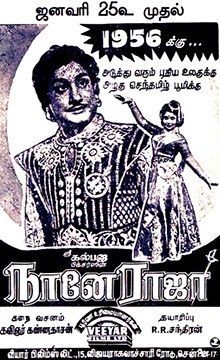 Naane Raja (1956)
- More like this film, on a shelf you can walk up to.It's the lit case on the top shelf.