Masculin Féminin (1966)

- Original title
- Masculin féminin
- Directed by
- Jean-Luc Godard
- Genre
- drama film, comedy drama
- Country
- France, Sweden
- Runtime
- 1h 44m
- Rated
- NR
- Rating
- 7.2 of 10 from 426 voters
- Elsewhere
- IMDb
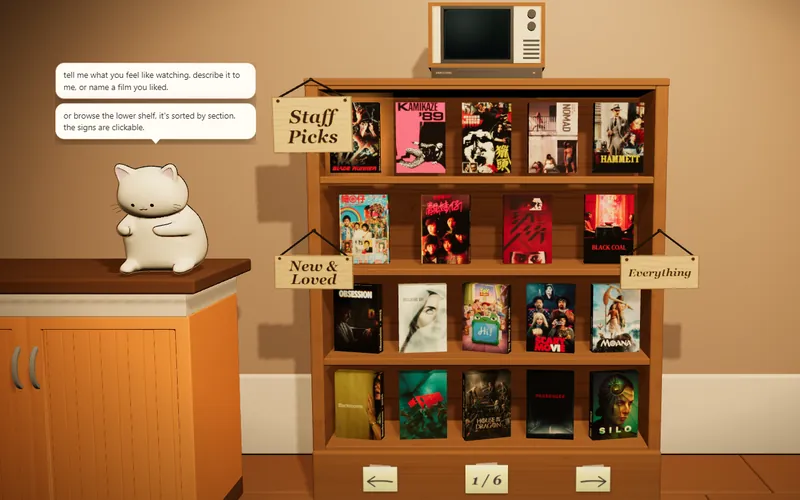
The catalogue in 3D
The film shelves have a room of their own that you can walk around in. The cat behind the counter is the AI Catbot, and they pick real films from the same catalogue when you tell them what you feel like watching. Nothing is for sale, here or in there. Go in from here and this film is already out on the counter, with more like it waiting on the shelf next to it.
How it feels
A young romantic idealist pursues a rising pop singer in 1960s Paris. They and her roommates share a flat and discuss love, sex, and politics. The film mixes their story with documentary-like interviews and brief interruptions that reference the era.
contemplativeromanticpoliticalplayfulmelancholicdisjointedtalkyyouthful
What happens
Masculin féminin: 15 Specific Events (French: Masculin féminin: 15 faits précis, pronounced [maskylɛ̃ feminɛ̃ kɛ̃z fe pʁesi]) is a 1966 French New Wave film, written and directed by Jean-Luc Godard. An international co-production between France and Sweden, the film stars Chantal Goya, Jean-Pierre Léaud, Marlène Jobert, Catherine-Isabelle Duport and Michel Debord. Léaud plays Paul, a romantic young idealist who chases budding pop star Madeleine (played by Goya, a real-life yé-yé singer). Despite markedly different musical tastes and political leanings, the two soon become romantically involved and begin a ménage à quatre with Madeleine's two roommates, Catherine (Duport) and Elisabeth (Jobert). The camera probes the young actors in a series of vérité-style interviews about love, sex, and politics. At times the main story is interrupted by various sequences and subplots, including a scene paraphrased from LeRoi Jones' play Dutchman. Masculin Féminin was intended as a representation of 1960s France and Paris. The film contains references to various pop culture icons and political figures of the time, such as Charles de Gaulle, André Malraux, James Bond, and Bob Dylan. Arguably the most famous quotation from the film is "This film could be called The Children of Marx and Coca-Cola", which is actually an intertitle between chapters. (from Wikipedia, CC BY-SA)
More like this
 The War Is Over (1966)
 I (1966)
 Ormen (1966)
 Living It Up (1966)
 The Princess (1966)
 A Man and a Woman (1966)
 Persona (1966)
 À nous deux, Paris! (1966)
- More like this film, on a shelf you can walk up to.It's the lit case on the top shelf.