Get Carter (1971)

- Directed by
- Mike Hodges
- Genre
- film noir, crime film
- Country
- United Kingdom
- Runtime
- 1h 47m
- Rated
- R
- Rating
- 7.0 of 10 from 570 voters
- Elsewhere
- IMDb

The catalogue in 3D
The film shelves have a room of their own that you can walk around in. The cat behind the counter is the AI Catbot, and they pick real films from the same catalogue when you tell them what you feel like watching. Nothing is for sale, here or in there. Go in from here and this film is already out on the counter, with more like it waiting on the shelf next to it.
How it feels
A London gangster goes back to his hometown in northern England after his brother dies. He suspects murder and starts asking questions, pushing his way through the local criminal underworld to find the truth and get revenge.
grimcoldmethodicalbleaktensegrittyretaliatoryhardboiled
What happens
Get Carter is a 1971 British gangster thriller film, written and directed by Mike Hodges in his directorial debut and starring Michael Caine, Ian Hendry, John Osborne, Britt Ekland and Bryan Mosley. Based on Ted Lewis's 1970 novel Jack's Return Home, the film follows Jack Carter (Caine), a London gangster who returns to his hometown in North East England after his brother's death. Suspecting foul play, and with vengeance on his mind, he investigates and interrogates, regaining a feel for the city and its hardened-criminal element. Producer Michael Klinger optioned Lewis's novel shortly after its publication and made a deal with the ailing Metro-Goldwyn-Mayer (MGM) to finance and release the film, making Get Carter the last project to be approved by the studio's Borehamwood division before its closure. The production went from novel to finished film in 10 months, with principal photography taking place from July to September 1970 in and around Newcastle upon Tyne, Gateshead and County Durham. Hodges, Klinger and Caine intended to create a more realistic portrayal of violence and criminal behaviour than had previously been seen in British films: Caine, who also served as an uncredited co-producer, incorporated aspects of criminal acquaintances into his characterisation of Carter, while Hodges conducted research into the criminal underworld of Newcastle, in particular the one-armed bandit murder. Cinematographer Wolfgang Suschitzky worked with Hodges to give scenes a naturalistic feel, drawing heavily on their backgrounds in documentary films. Turning a respectable profit upon its initial UK release, Get Carter initially attracted mixed reviews. Critics grudgingly appreciated the film's technical achievements and Caine's performance while criticising the complex plot, violence and amorality, in particular Carter's apparent lack of remorse for his actions. American critics were generally more enthusiastic, but the film languished on the drive-in circuit, while MGM focused its resources on producing Hit Man, a 1972 blaxploitation-themed remake of the film. Get Carter eventually garnered a cult following, and further endorsements from directors such as Quentin Tarantino and Guy Ritchie led to the film being critically re-evaluated, with its depiction of class structure and life in 1970s Britain and Roy Budd's minimalist jazz score receiving considerable praise. In 1999, Get Carter was ranked 16th on the BFI Top 100 British films of the 20th century; five years later, a survey of British film critics in Total Film magazine chose it as the greatest British film of all time. A poorly received remake also titled Get Carter was released in 2000, with Sylvester Stallone portraying Jack Carter and Caine in a supporting role. (from Wikipedia, CC BY-SA)
More like this
 A Clockwork Orange (1971)
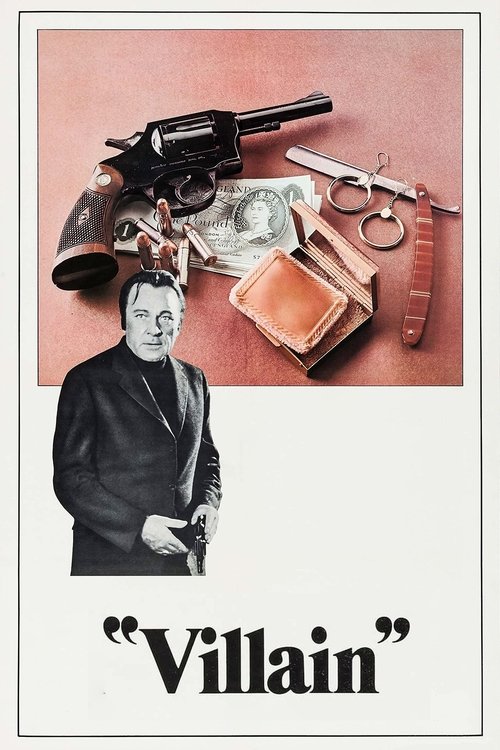 Villain (1971)
 Mongo's Back in Town (1971)
 Angel's Leap (1971)
 Purgatory (1971)
 Countdown to Vengeance (1971)
 The Dark Man (1951)
 Home to Danger (1951)
- More like this film, on a shelf you can walk up to.It's the lit case on the top shelf.