Breaker Morant (1980)

- Directed by
- Bruce Beresford
- Genre
- trial film
- Country
- Australia
- Runtime
- 1h 47m
- Rated
- PG
- Rating
- 7.1 of 10 from 160 voters
- Elsewhere
- IMDb

The catalogue in 3D
The film shelves have a room of their own that you can walk around in. The cat behind the counter is the AI Catbot, and they pick real films from the same catalogue when you tell them what you feel like watching. Nothing is for sale, here or in there. Go in from here and this film is already out on the counter, with more like it waiting on the shelf next to it.
How it feels
Three Australian soldiers in the British Army are court-martialed for killing prisoners and a civilian during the Boer War. The movie follows their trial and shows what happened through flashbacks.
tensesombermeasuredhistoricalcerebralunflinchingseriousprovocative
What happens
Breaker Morant is a 1980 Australian biographical war drama film directed by Bruce Beresford, who also co-wrote the screenplay based on Kenneth G. Ross's 1978 play of the same name. It stars Edward Woodward as the title character, Lt. Harry Harbord "Breaker" Morant, along with Jack Thompson, John Waters, and Bryan Brown. The film concerns the 1902 court martial of lieutenants Morant, Peter Handcock and George Witton—one of the first war crime prosecutions in British military history. Australians serving in the British Army during the Second Anglo-Boer War, Morant, Handcock, and Witton stood accused of murdering captured enemy combatants and an unarmed civilian in the Northern Transvaal. The film is notable for its exploration of the Nuremberg Defence, the politics of the death penalty and the human cost of total war. As the trial unfolds, the events in question are shown in flashbacks. The film won ten 1980 Australian Film Institute Awards including: Best Film, Best Direction, Best Screenplay, Best Leading Actor (for Jack Thompson) and Best Supporting Actor (Bryan Brown). It was also nominated for an Academy Award for the Best Adapted Screenplay. Breaker Morant remains the movie with which Beresford is most identified and has "hoisted the images of the accused officers to the level of Australian icons and martyrs". In a 1999 interview Beresford said Breaker Morant "never pretended for a moment" that the defendants were not guilty as charged. He had intended the film to explore how wartime atrocities can be "committed by people who appear to be quite normal". Beresford concluded that he was "amazed" that so many people see his film as being about "poor Australians who were framed by the Brits". (from Wikipedia, CC BY-SA)
More like this
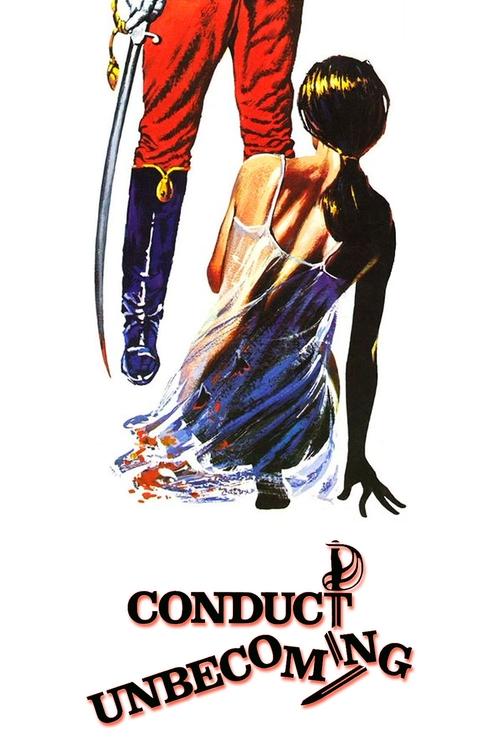 Conduct Unbecoming (1975)
 Paths of Glory (1957)
 Judgment at Nuremberg (1961)
 Man in the Middle (1963)
 Shaurya (2008)
 The Passion of Joan of Arc (1928)
 Carrington V.C. (1955)
 Sergeant Rutledge (1960)
- More like this film, on a shelf you can walk up to.It's the lit case on the top shelf.