Desire (1986)

- Original title
- 心鎖
- Directed by
- Ho Fan
- Genre
- drama film
- Country
- Taiwan
- Runtime
- 1h 20m
- Rating
- 1.0 of 10 from 2 voters
- Elsewhere
- IMDb
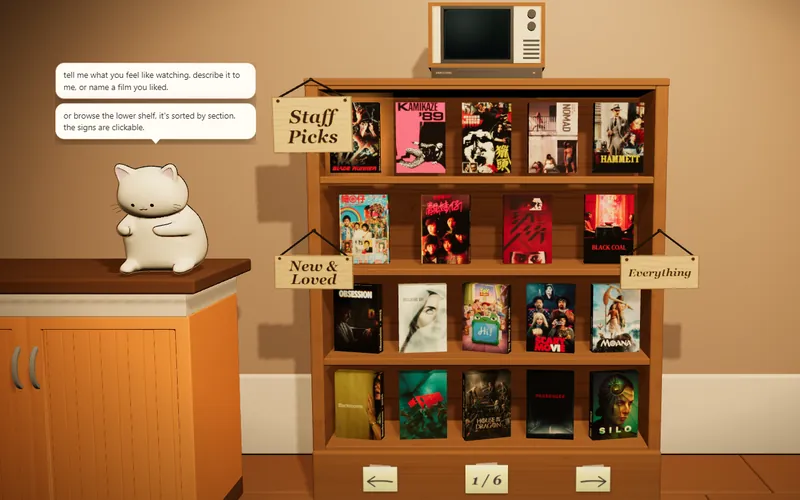
The catalogue in 3D
The film shelves have a room of their own that you can walk around in. The cat behind the counter is the AI Catbot, and they pick real films from the same catalogue when you tell them what you feel like watching. Nothing is for sale, here or in there. Go in from here and this film is already out on the counter, with more like it waiting on the shelf next to it.
How it feels
A married woman named Hsia Tanchi has affairs with her ex-boyfriend and her brother-in-law. The film shows her inner conflict and the scandal that erupts when her actions are discovered.
melodramatictensecontroversialyearningguilt-riddenprovocativesombertaboo
What happens
Heart Lock is Taiwanese writer Gloria Liang-Hui Kuo’s work. It was initially serialized in the Human Realm supplement of Credit Investigation Newspaper in 1962 and later published by Da Ye Bookstore in September of the same year. The intricacies of romantic entanglements between men and women, as well as the incestuous relations among relatives inside the plot, garnered criticism from female writers. Consequently, the work faced a ban until its reemergence in 1986, when it was reintroduced as a film adaptation under the same title. This controversy also led to Kuo’s banishment from two renowned literary associations at that time. This work depicts the protagonist, Hsia Tanchi, engaging in intercourse with men other than her husband, including her ex-boyfriend and her brother-in-law, as well as her inner struggle. As a result, female writers at the time such as Su Hsueh-lin (蘇雪林) and Xie Bing-ying (謝冰瑩) denounced the work with disparaging remarks like "moral corruption," "incest," etc. This sparked a controversy that eventually led to the banning of the work. The literary community also engaged in spirited debates regarding the assessment of this piece. With the lifting of the ban on this work in 1986 and the rise of women's literature research in Taiwan, researchers reassessed the work from the perspective of female liberty and the social context of the 1950s: Chang Shu-li (張淑麗), a scholar of literature, believes that the daring depiction of sexuality in this work and the resultant controversies sparked multifaceted reflections among readers regarding literature and society, aesthetics and politics, as well as eroticism and moral norms. Fan Ming-ju (范銘如), another scholar of literature, interprets this work as a probe of gender politics, as it emphasizes the querying of female subjectivity, deconstructs hegemonic discourses, and employs multiple, fragmented, and unstable female identities to highlight the arbitrariness of mainstream ideologies. Ying Feng-huang (應鳳凰), also scholar of literature, seeing the work from the narrative standpoint of Taiwanese literary history, contends that this work cannot be categorized as anti-communist literature of the 1950s or as modern literature of the 1960s, which offers reflections on narrative issues in the history of Taiwanese literature. (from Wikipedia, CC BY-SA)
More like this
 Desire (1986)
 The Terrorizers (1986)
 This Love of Mine (1986)
 Jade Love (1986)
 Dust in the Wind (1986)
 Echo of Sea (1986)
 Outcasts (1986)
 Midnight Whispers (1986)
- More like this film, on a shelf you can walk up to.It's the lit case on the top shelf.