Star Trek (2009)

- Directed by
- J. J. Abrams
- Genre
- drama film, action film, science fiction film, adventure film
- Country
- United States
- Runtime
- 2h 07m
- Rated
- PG-13
- Rating
- 7.4 of 10 from 10,569 voters
- Elsewhere
- IMDb
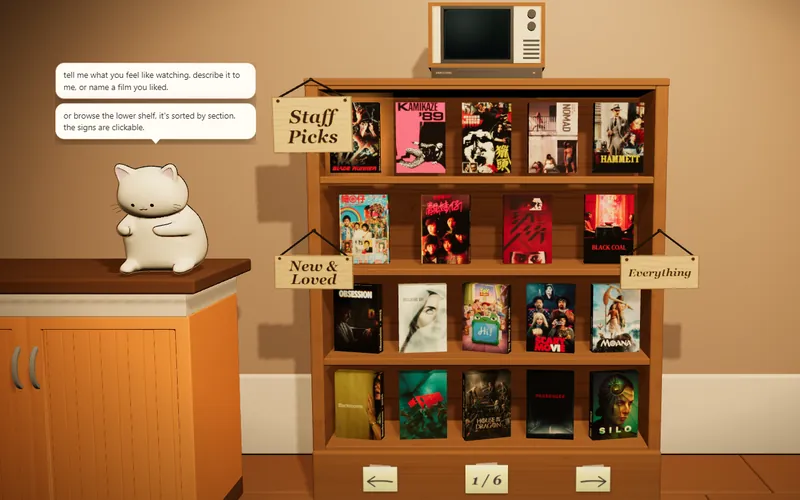
The catalogue in 3D
The film shelves have a room of their own that you can walk around in. The cat behind the counter is the AI Catbot, and they pick real films from the same catalogue when you tell them what you feel like watching. Nothing is for sale, here or in there. Go in from here and this film is already out on the counter, with more like it waiting on the shelf next to it.
How it feels
A younger James Kirk and Spock meet as new Starfleet officers and must work together aboard the USS Enterprise. They face a Romulan from the future who threatens to destroy Earth and the entire Federation.
fast-pacedadventurousbombasticslickheroicnostalgicoptimisticfun
What happens
Star Trek is a 2009 American science fiction action film directed by J. J. Abrams, and written by Roberto Orci and Alex Kurtzman. It is the 11th film in the Star Trek franchise, and is also a reboot that features the main characters of the original Star Trek television series portrayed by a new cast, as the first in the rebooted film series. The film follows James T. Kirk (Chris Pine) and Spock (Zachary Quinto) aboard the USS Enterprise as they combat Nero (Eric Bana), a Romulan from their future who threatens the United Federation of Planets. The story takes place in an alternate reality that features both an alternate birth location for James T. Kirk and further alterations in history stemming from the time travel of both Nero and the original series Spock (Leonard Nimoy). The alternate reality was created in an attempt to free the film and the franchise from established continuity constraints while simultaneously preserving original story elements. The idea for a prequel film which would follow the Star Trek characters during their time in Starfleet Academy was first discussed by the series creator, Gene Roddenberry, in 1968. The concept resurfaced in the late 1980s, when it was postulated by Harve Bennett as a possible plotline for what would become Star Trek VI: The Undiscovered Country, but it was rejected in favor of other projects by Roddenberry. Following the critical and commercial failure of Star Trek: Nemesis and the cancellation of Star Trek: Enterprise, the franchise's executive producer, Rick Berman, and the screenwriter Erik Jendresen wrote an unproduced film titled Star Trek: The Beginning, which would take place after Enterprise. After the separation of Viacom and CBS Corporation in 2005, former Paramount Pictures president Gail Berman convinced CBS to allow Paramount to produce a new film in the franchise. Orci and Kurtzman were soon approached to write the film, and Abrams was approached to direct it. Kurtzman and Orci used inspiration from novels and graduate school dissertations, as well as the series itself. Principal photography occurred between November 2007 and March 2008, in locations around California and Utah. Abrams wanted to avoid using greenscreen, and preferred sets and locations instead. Heavy secrecy surrounded the production of the film, which was under the fake working title Corporate Headquarters. Industrial Light & Magic used digital ships for the film, as opposed to miniatures used in most of the previous films in the franchise. Production for the film concluded by the end of 2008. Star Trek was heavily promoted in the months preceding its release; pre-release screenings for the film premiered in select cities around the world, including Austin, Sydney, and Calgary. It was released in the United States on May 8, 2009, to critical acclaim. The film was a financial success, grossing over $385.7 million worldwide against its $150 million production budget. It was nominated for several awards, including four at the 82nd Academy Awards, winning Best Makeup—the only Academy Award a Star Trek film has won. It was followed by the sequels Star Trek Into Darkness (2013) and Star Trek Beyond (2016). (from Wikipedia, CC BY-SA)
More like this
 Star Trek Into Darkness (2013)
 Star Trek Beyond (2016)
 Alien (1979)
 765874 - Unification (2024)
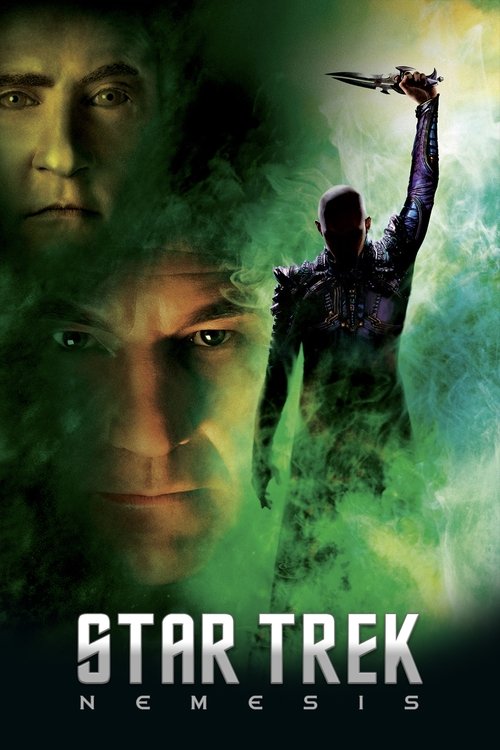 Star Trek: Nemesis (2002)
 Star Trek III: The Search for Spock (1984)
 Star Trek: First Contact (1996)
 Star Trek VI: The Undiscovered Country (1991)
- More like this film, on a shelf you can walk up to.It's the lit case on the top shelf.