Ultraman (1966)

- Original title
- ウルトラマン
- Genre
- Japanese television drama, tokusatsu
- Country
- Japan
- Length
- 1 season, 39 episodes
- Rated
- TV-PG
- Rating
- 8.4 of 10 from 60 voters
- Elsewhere
- IMDb

The catalogue in 3D
The film shelves have a room of their own that you can walk around in. The cat behind the counter is the AI Catbot, and they pick real films from the same catalogue when you tell them what you feel like watching. Nothing is for sale, here or in there. Go in from here and this series is already out on the counter, with more like it waiting on the shelf next to it.
How it feels
A giant hero from outer space merges with a human to defend Earth from giant monsters and alien threats. It is a Japanese TV show from the 1960s that started a long-running franchise.
retroaction-packedheroicfunoptimisticlarger-than-lifefast-pacedmythic
What happens
Ultraman (Japanese: ウルトラマン, Hepburn: Urutoraman) is a Japanese tokusatsu science fiction television series created by Eiji Tsuburaya. Produced by Tsuburaya Productions, it is a follow-up to Ultra Q, though not technically a sequel or spin-off. Tsuburaya Productions produced 39 episodes (40, counting the pre-premiere special) that aired on Tokyo Broadcasting System (TBS) and its affiliate stations from July 17, 1966, to April 9, 1967. Its premiere topped the average rating set by Ultra Q and kept climbing each week, marking the show as a success. It was also the first Japanese television series to use a bidding system for commercial rights, allowing multiple third-party companies to sponsor the show. This was following TBS's merchandising troubles with its predecessor. Although Ultraman is the first series to feature an Ultraman character, it is the second installment in the Ultra Series, following Ultra Q. This is symbolised by the Japanese show opening with the Ultra Q logo exploding into the Ultraman logo. Ultraman and its titular hero became a major pop culture phenomenon in Japan, generating dozens of sequels, spin-offs, imitations, parodies and tributes. Ultraman went on to generate $7.4 billion in merchandising revenue from 1966 to 1987 in Japan (equivalent to more than $21 billion adjusted for inflation) and become the world's third top-selling licensed character by the 1980s, largely due to his popularity in Asia. A manga series of the same name serving as a sequel to the television series began publication in October 2011 and received an anime adaptation starting in April 2019. In May 2022, Toho released Shin Ultraman, a reimagining of the series directed by Shinji Higuchi. (from Wikipedia, CC BY-SA)
More like this
 Ultraseven (1967)
 Ultra Q (1966)
 Jikuu Senshi Spielban (1986)
 Ultraman Tiga (1996)
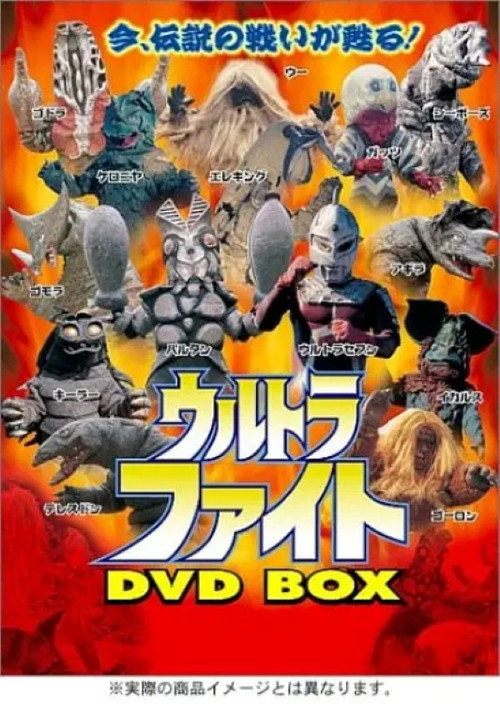 Ultra Fight (1970)
 The Return of Ultraman (1971)
 Jamila
 National Kid (1960)
- More like this series, on a shelf you can walk up to.It's the lit case on the top shelf.