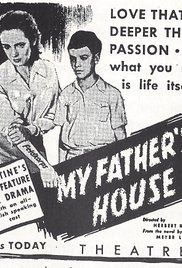
My Father's House (1947)
- Original title
- בית אבי
- Directed by
- Herbert Kline, Józef Lejtes
- Genre
- drama film
- Country
- Mandatory Palestine
- Runtime
- 1h 24m
- Rating
- 3.5 of 10 from 3 voters
- Elsewhere
- IMDb

The catalogue in 3D
The film shelves have a room of their own that you can walk around in. The cat behind the counter is the AI Catbot, and they pick real films from the same catalogue when you tell them what you feel like watching. Nothing is for sale, here or in there. Go in from here and this film is already out on the counter, with more like it waiting on the shelf next to it.
How it feels
A young boy travels across Mandatory Palestine to find his father. He encounters various people and places along the way.
earnestplaintivemildly sentimentaljournalistichomespunatmosphericpoignant
What happens
My Father's House (Hebrew: בית אבי) is a 1947 British Mandatory Palestine-American drama film directed by Herbert Kline, with a script by Jewish-American novelist and journalist Meyer Levin. Kline and Levin produced the film. The cinematography is by Floyd Crosby. The film was an official selection of the 1950 Venice Film Festival. One of the lead actors was the Israeli sculptor Yitzhak Danziger, who was cast due to his exotic appearance. At the time, Ronnie Cohen, the lead actor, was nine years old. He had been born in Britain to a Zionist family and had immigrated to Israel when he was three. The director spent a few months looking for an English-speaking child until he found Cohen through the film's make-up artist, who was the hairdresser of Cohen's mother. The music is mainly composed of Hebrew folk songs and occasionally Maller-Kalikstein music; the music editor was Henry Brandt. The locations were all in Mandatory Palestine, and are now Israel: Afikim, Ginosar, Gvulot, Kfar Hittim, Kinneret, Kiryat Anavim, Ma'ale HaHamisha, Ma'abarot, Nirim and Ramat Rachel. This is an English-speaking film because it was made for the American-Jewish audience. The budget was provided mainly from wealthy Jewish residents of Palestine and Americans, and the remainder from Zionist institutions. (from Wikipedia, CC BY-SA)
More like this
 The Great Promise (1947)
 Adamah (1949)
 Pioneers of Palestine (1933)
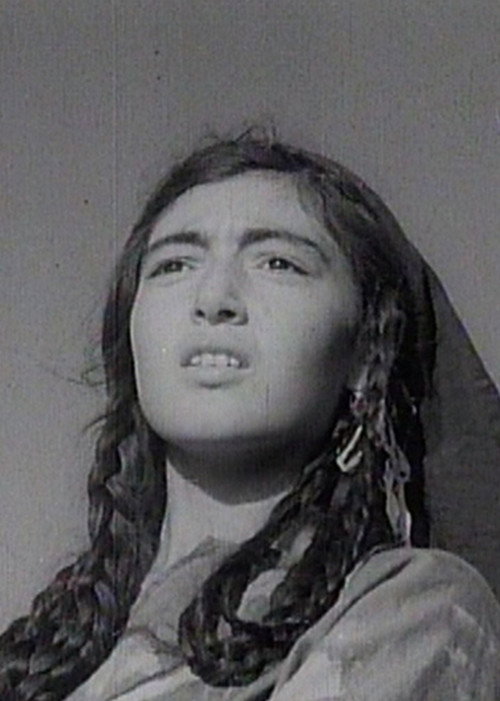 Upon the Ruins (1938)
 When I Saw You (2012)
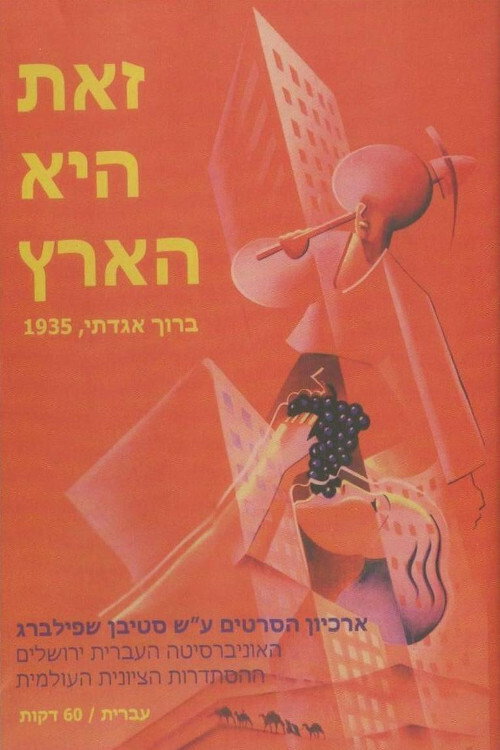 This Is the Land (1935)
 Sword in the Desert (1949)
 Work (1935)
- More like this film, on a shelf you can walk up to.It's the lit case on the top shelf.